Signal draws a new boundary around private conversations
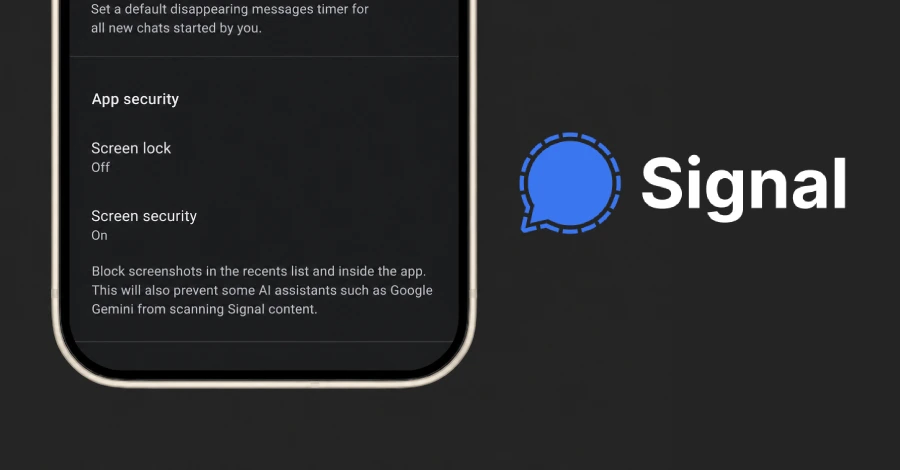
Signal is introducing stronger screen-capture restrictions as artificial intelligence assistants gain deeper access to mobile operating systems. The encrypted messaging service says supported versions of its app will block screenshots by default when the operating system or an AI assistant attempts to capture conversation content. The change is designed to prevent private messages from leaving Signal's protected environment through a route that end-to-end encryption cannot control.
The move addresses a fundamental change in how phones work. AI agents are being designed to observe screens, understand displayed information and take actions across applications. Those abilities can be useful for booking appointments, summarising messages or completing routine tasks. They can also expose sensitive information when an assistant captures a private chat, extracts the text and processes it through another system that operates under different privacy rules.
Why encryption alone cannot solve screen access
End-to-end encryption protects a message while it travels between participants and while it is handled by the messaging service. It does not prevent another authorised process on the device from viewing the message after it appears on the screen. An AI assistant with broad accessibility, screen-reading or screenshot permissions may therefore reproduce content without breaking the encryption protocol itself. The weakness sits at the operating-system layer rather than inside the encrypted connection.
That distinction matters because users may believe that a secure messenger guarantees confidentiality in every circumstance. In practice, privacy depends on the complete device environment. Once another application captures a conversation, the copied content may be stored locally, transferred to a remote server or retained in an agent's activity history. Disappearing messages can also lose their intended protection if a separate service records them before they vanish.
How the new Signal privacy protections work
On supported Apple mobile software, Signal is enabling a setting that prevents the latest Siri-based artificial intelligence functions from capturing the app's screen. On Android distributions where attempted AI access can be detected, the application will automatically activate its existing screen-security control. People who need ordinary screenshots can switch the protection off, but the app will warn that doing so can expose their own content and the messages of other participants.
The implementation cannot be identical across every device because Android manufacturers provide different system behaviour and detection tools. Signal has also said it cannot reliably apply the same safeguard to screenshots on macOS. Users of that desktop system are instead advised to exclude the application from proactive Siri access through system settings. These gaps show why one developer cannot create a complete defence without cooperation from operating-system providers.
AI assistants create a new permission problem
Traditional app permissions were built around relatively narrow functions such as accessing a camera, microphone, contact list or location. Agentic systems combine several permissions and use them dynamically. An assistant may navigate the interface, read text, capture images and open files as part of one task. A person can technically approve each capability while still failing to anticipate how the combination might be used against a privacy-sensitive application.
Accessibility tools create a particularly difficult tension. They are essential for people who need assistance interacting with devices, yet the same broad controls can be repurposed by automated agents. Removing those capabilities would harm legitimate users. Leaving them unrestricted can let an agent operate like a universal key. The challenge is to distinguish a human-directed accessibility action from automated collection that an application has explicitly rejected.
The dispute now moves to Apple, Google and Microsoft
Signal wants major operating-system companies to give developers a clear, documented way to opt out of artificial intelligence processing. That protection would need to cover screen reading, notifications, files, system frameworks and other paths through which an agent can obtain data. The service is also asking for technical documentation that explains when information is captured, where it is processed and what controls are available to applications and users.
The request could shape a wider industry standard. Banking, healthcare, password-management and workplace applications face the same issue whenever an assistant can inspect protected information after the user opens it. A reliable opt-out would let developers preserve application-level promises without disabling useful device features. Without such a mechanism, privacy becomes dependent on changing operating-system behaviour that outside developers may discover only after a problem occurs.
What comes next
The immediate test will be whether the new restrictions work consistently across supported phones without confusing people who use screenshots for legitimate reasons. Clear warnings and simple controls will be important because a protection that users routinely disable will offer limited value. Independent security researchers will also examine whether agents can reach the same content through notifications, files or accessibility channels that do not require a conventional screenshot.
The larger issue is whether device makers accept that applications need enforceable boundaries against artificial intelligence agents. Signal's decision turns a technical concern into a public policy question about consent, shared conversations and the limits of broad system permissions. The answer will influence far more than one messenger as agentic software becomes a standard part of consumer devices.
PUBLISHED BY SUYASH PACHAURI, FOUNDER & OWNER, GLOBAL BOLLYWOOD | THE HOLLYWOOD SCOPE.