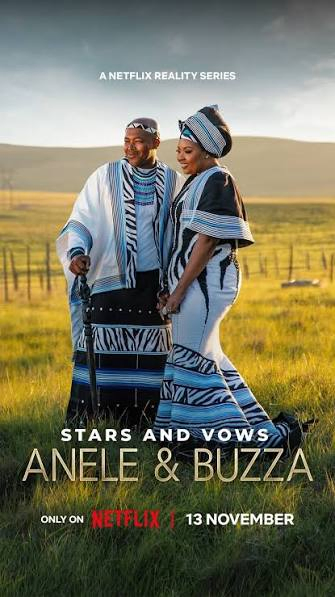
A celebrity wedding becomes the setting for a South African reality series that is less interested in the wedding day alone than in everything that must happen before two families can celebrate together. Stars and Vows: Anele & Buzza premiered on Netflix on 13 November 2026. It centres on broadcaster Anele Mdoda and Bonelela Mgudlwa, widely known as Buzza James, whose preparations for marriage give the programme a natural dramatic framework. The four instalments are already listed in the South African catalogue, making this an opportunity to explore the format beyond the initial publicity surrounding its release.
From wedding preparations to a family portrait
Mdoda is a familiar television and radio personality in South Africa, while Mgudlwa combines a career in law with his background as an AbaThembu prince. Their different public identities give the production a distinctive starting point. A wedding brings the two into a shared space where decisions about ceremonies, venues and hospitality must accommodate relatives as well as the couple themselves. Fame may make the occasion particularly visible, but it does not remove the everyday difficulty of balancing competing expectations.
The programme belongs to the documentary soap tradition rather than the competitive dating format. There is no elimination system driving the narrative, and the central couple has already established a relationship. Its appeal instead lies in observing what happens when plans involving many participants become increasingly complicated. For audiences who enjoy relationship programmes but prefer an unfolding family story to a contest between strangers, that distinction provides a useful indication of the viewing experience.
Four episodes and their running times
The South African title listing gives the individual running times as 44, 45, 53 and 40 minutes. Together they amount to three hours and two minutes, approximately the duration of a long feature film with an extended intermission. The story travels through several locations, with early celebrations in Kenya, preparations in Stellenbosch and a concluding visit to Mgudlwa's ancestral home.
The opening half
The opening instalment introduces the scale of the celebrations and the challenge of keeping arrangements on track while concerns emerge among relatives. Episode two shifts the focus towards the cost of the occasion and the different experiences of the bridal and bachelor parties. These early chapters establish the competing priorities that give the subsequent logistical difficulties their emotional significance. The viewer understands why resolving a practical problem matters to more people than the person who first raised it.
The concluding half
At 53 minutes, the third episode is the longest instalment. It places an unresolved venue requirement at the centre of the preparations in Stellenbosch, with very little time remaining before the wedding. The fourth moves the setting towards the groom's family roots and the role of inherited traditions. That geographical change broadens the significance of the wedding beyond its visual spectacle, connecting a highly public celebration to a more enduring sense of belonging.
The creative approach behind the documentary soap
Nomzamo Mbatha, Teddy Geldart, Vuyo Sowah and Pet Tasara are credited as creators, with Pascual Wakefield directing. The premise presents an interesting production challenge because a wedding crew has to anticipate decisive moments without assuming control of the real occasion. Camera access, the positioning of contributors and the selection of transitional material are all consequential. A conversation away from the principal ceremony can communicate the pressure behind a decision that might otherwise appear insignificant on screen.
The structure also illustrates the difference between recording an event and building an episodic narrative. A documentary wedding film can concentrate on a chronological account of the occasion itself. A multi-part series needs several independently intelligible chapters, each with its own tension and payoff. By organising its material around distinct locations and phases of preparation, Stars and Vows has a framework for developing that progression without introducing an artificial competition.
A window into contemporary South African storytelling
The cultural dimension gives the series a point of distinction in a crowded field of celebrity reality programmes. The couple's ceremonies offer a way to encounter specific family practices and the importance attached to kinship. International viewers should approach those details as the traditions and choices of the people shown, rather than treating a single wedding as representative of every community in South Africa. The programme's specific regional setting is part of its identity, not merely a decorative background for a universal romance.
For filmmakers, the project is also worth considering as an example of how local cultural detail can travel through a familiar entertainment format. The wedding provides an immediately recognisable premise while allowing the participants' own social context to shape the story. This is one route by which unscripted productions can reach international viewers without abandoning the particular customs, humour or concerns that distinguish their home audiences.
Viewing information for international audiences
The South African Netflix catalogue lists all four episodes, identifies English as the original audio and includes English audio description, Hindi audio and English subtitles in that regional listing. The Indian public title page carries a U/A 13+ classification but does not currently expose an episode list or audio menu in the retrieved version. Indian readers should therefore confirm playback and language choices from their own accounts instead of assuming that every South African accessibility option will be identical locally. The British title page displays a classification of 12. Regional classifications are not interchangeable.
The November premiere is no longer a forthcoming announcement. It is a completed launch that can be revisited for its approach to wedding television, the relationship between private experience and public storytelling, and the practical question of whether the compact series suits an evening's viewing. No conclusion about the quality of the completed episodes is intended here: this is a spoiler-conscious programme guide, not a review based on watching the entire production.
PUBLISHED BY SUYASH PACHAURI, FOUNDER & OWNER, GLOBAL BOLLYWOOD | THE HOLLYWOOD SCOPE.