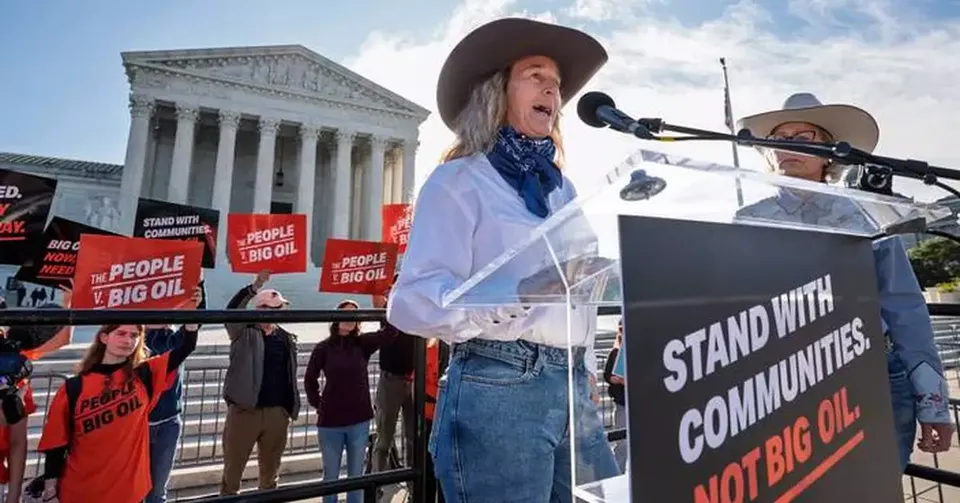
A Supreme Court climate lawsuit involving Boulder, Colorado, ExxonMobil and Suncor Energy will open the court's new term with consequences far beyond one city. Boulder is seeking monetary damages for past and future costs linked to climate change, including infrastructure repairs, environmental harm, emergency management and public-health effects. The companies want the case dismissed, arguing that federal law governs the field and prevents state-law claims. A broad ruling for the energy companies could threaten nearly 60 similar cases brought by state and local governments.
What Boulder Alleges in the Big Oil Climate Case
The city and county governments accuse the companies of contributing to climate change and misleading the public about the risks of fossil fuels. Their case relies on state law rather than asking a court to set national emissions policy. That distinction is crucial. Boulder frames the dispute as one about deceptive conduct and local damages, while the defendants say the claims would effectively regulate global production and emissions through a patchwork of state lawsuits.
Lower courts allowed the lawsuit to proceed, and the Colorado Supreme Court declined to end it. Exxon and Suncor appealed to the nation's highest court with support from the federal administration. Their central argument is that the Clean Air Act and federal common-law principles leave climate regulation to national institutions. They also warn that a state court could impose liability for conduct occurring across borders, giving one jurisdiction power over worldwide energy activity.
Why the Supreme Court Climate Lawsuit Is a Bellwether
Communities across the United States have filed cases seeking billions of dollars from fossil-fuel companies. Many face rising costs from heat, fires, storms, sea-level change and damaged infrastructure. Local governments argue that taxpayers should not bear every expense if companies concealed known risks. The industry responds that energy was lawfully produced, widely used and regulated by governments, making retrospective liability unfair and economically disruptive. The court's reasoning could decide whether those arguments are tested at trial or blocked at the threshold.
Federal Pre-emption Versus State Consumer Protection
The technical legal question concerns pre-emption, the principle that federal law can displace state rules in areas assigned to national authority. If the justices characterize Boulder's claims as emissions regulation, the companies have a stronger argument. If the case is treated as traditional state-law misconduct involving alleged deception and damages, Boulder has more room to proceed. The language of the ruling will matter because courts handling other climate suits will use it to decide where that boundary lies.
Justice Samuel Alito has recused himself from the case. Financial disclosures show that he owns shares in several oil and gas companies, though not the two defendants. His absence leaves eight justices and creates the possibility of a 4-4 split. An evenly divided court would leave the lower-court result in place without creating a nationwide precedent, allowing Boulder's suit to continue while similar disputes develop elsewhere.
The Decision Could Reshape Corporate Climate Accountability
If the companies win broadly, many local cases could be dismissed before evidence about corporate knowledge and public communication is examined. That would shift accountability toward legislation and federal regulation. If Boulder prevails, the ruling would not automatically prove liability. It would permit litigation to move forward, including discovery, expert evidence and arguments over causation. Trials would still need to connect specific conduct to legally recognized harm and determine a defensible measure of damages.
The case also tests institutional competence. Courts are designed to resolve concrete disputes, but climate change is global, cumulative and shaped by countless producers and consumers. Legislatures can create comprehensive rules, while lawsuits focus on individual defendants and past conduct. Yet the absence of complete legislation does not necessarily erase state remedies for alleged deception. The justices must decide whether allowing those remedies complements federal policy or interferes with it.
A decision is expected by the end of June. Whatever the outcome, the Supreme Court climate lawsuit will influence how cities plan for growing climate costs and how energy companies describe historical knowledge and future risk. Investors and insurers will also watch whether potential liabilities can be estimated or remain open-ended across dozens of jurisdictions. Local taxpayers have a direct financial interest in that answer. The most durable ruling would draw a clear line between national emissions policy and ordinary state-law accountability. Without that clarity, governments and companies will continue fighting over jurisdiction before courts ever reach the evidence at the center of the allegations.
PUBLISHED BY SUYASH PACHAURI, FOUNDER & OWNER, GLOBAL BOLLYWOOD | THE HOLLYWOOD SCOPE.