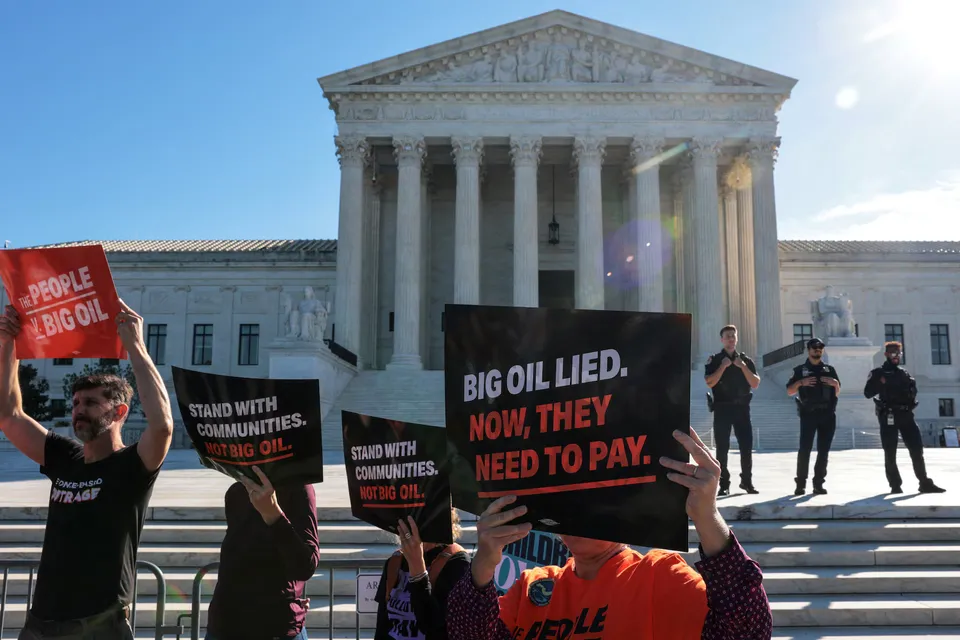
A case before the US Supreme Court could determine whether cities and states can pursue climate-damage claims against major oil companies under local law. Boulder, Colorado, is seeking compensation for infrastructure costs, environmental harm and public-health impacts it links to climate change and alleged corporate deception. The companies argue that federal law, particularly the Clean Air Act, blocks these claims. Because nearly 60 state and local governments have filed related lawsuits, the decision could either preserve a major avenue of climate accountability or close it across much of the country.
What the Supreme Court Climate Case Is About
Boulder's complaint is not framed as a request for the court to set national emissions policy. It seeks damages under state law, arguing that fossil-fuel producers contributed to climate harm and misled the public about the consequences of their products. That distinction is central. The city says courts routinely hear claims involving deceptive conduct and local injury. The defendants respond that emissions and global warming are inherently national and international issues, so allowing state-law cases would create a patchwork of liability that interferes with federal authority.
The legal doctrine at issue is preemption, which determines when federal law displaces state rules. The companies contend that the Clean Air Act gives the federal government primary control over emissions and therefore prevents local climate suits. Some justices questioned whether the statute reaches claims based on marketing and deception rather than direct regulation of smokestacks or tailpipes. Others appeared concerned that damages could indirectly force companies to change behavior nationwide. The final ruling may turn on how narrowly the court defines the city's theory.
Why the Case Matters Beyond Boulder
Communities across the United States face rising costs from heat, wildfire, flooding, drought and severe storms. Local governments argue that taxpayers should not carry the entire burden of adapting roads, water systems and emergency services. Oil companies warn that climate change results from billions of consumption decisions and government policies, making selective liability unfair and legally incoherent. A broad ruling for the defendants could discourage dozens of pending cases before they reach fact-finding. A narrower decision could leave room for claims focused on alleged misrepresentation.
The litigation also affects access to internal documents. If cases proceed into discovery, plaintiffs may obtain records about corporate research, public statements and risk assessments. That evidence could shape public understanding even before a trial. Companies have strong incentives to resolve jurisdictional and preemption questions early, while municipalities want the opportunity to test their allegations with a factual record. The Supreme Court's approach will therefore influence not only damages but also how much evidence becomes available.
Eight Justices Are Hearing the Dispute
Justice Samuel Alito is not participating because of financial interests, leaving eight members to decide the case. An evenly divided result would have unusual consequences, potentially leaving the lower-court decision in place without a nationwide precedent. The remaining bench has a conservative majority, but questions during argument showed that statutory interpretation may not follow a simple ideological split. The liberal justices expressed skepticism that the Clean Air Act automatically bars the city's claims and raised the possibility that the dispute reached the court too early.
The Difference Between Regulation and Compensation
A key distinction is whether damages function like emissions regulation. If a court orders compensation for past deception, supporters say it is applying ordinary state law. If potential liability is so large that it dictates future production and sales, opponents say it becomes regulation by another name. Courts have handled similar tensions in tobacco, opioids and environmental contamination cases. Climate change is more complex because emissions mix globally and damage accumulates over decades. The Supreme Court must decide which legal tools remain available without attempting to design climate policy from the bench.
The court could choose a narrow path that resolves only the procedural question before it. Such a ruling might allow some claims to continue while leaving broader questions for later cases. That outcome would preserve uncertainty but avoid writing a sweeping rule before a factual record exists. Businesses, investors and municipalities will scrutinize the exact language because small distinctions about causation, deception and requested remedies may determine which future lawsuits survive.
A Ruling With Long-Term Consequences
A decision is expected by the end of June 2027. Whatever the outcome, Congress and regulators will retain authority to create clearer national rules, but political gridlock makes litigation especially consequential. A ruling for Boulder would not guarantee it wins damages; it would allow the case to proceed through evidence and trial. A ruling for the companies could end many local claims at an early stage. The Supreme Court climate case is therefore a gateway dispute about who may seek accountability, which evidence can be tested and how the costs of a warming climate are distributed.
PUBLISHED
BY
SUYASH PACHAURI,
FOUNDER & OWNER,
GLOBAL BOLLYWOOD | THE HOLLYWOOD SCOPE