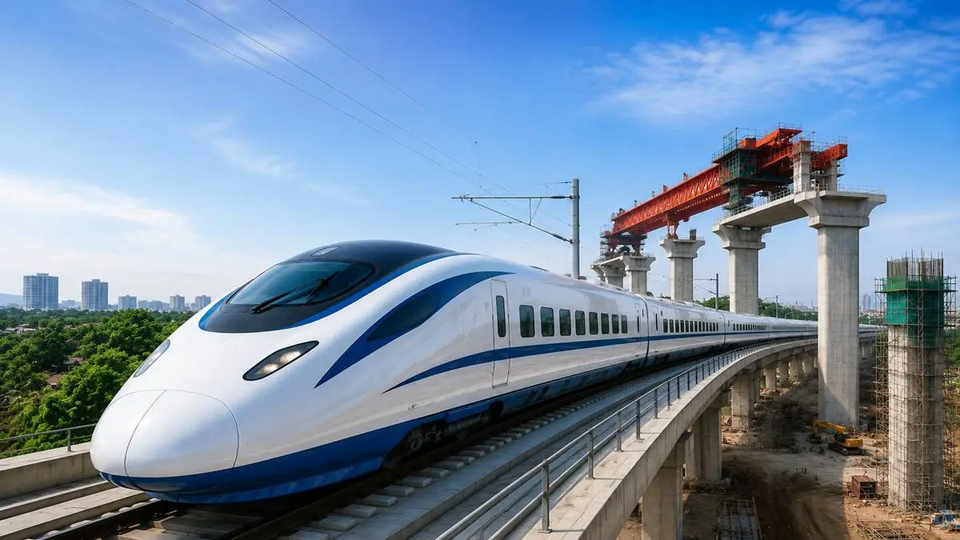
Power Reaches the First 50-Kilometre Section
The Mumbai-Ahmedabad high-speed rail project has energised the overhead electrical system on the 50-kilometre Surat-Bilimora section in Gujarat. Power was introduced on 20 November across both the up and down lines of the elevated alignment. The milestone moves India's first bullet train corridor toward further testing, although it does not mean the section is ready for passenger operations.
Technical teams will energise smaller portions progressively and monitor them under controlled procedures. The work tests more than the presence of electricity. Engineers must confirm that substations, switching equipment, protection systems, overhead wires and central controls operate together safely. Any defect in insulation, alignment or communication has to be identified before dynamic train trials begin.
How the High-Speed Power System Works
The corridor uses a 2 by 25 kilovolt overhead traction system, a configuration designed to transmit power efficiently over long distances for high-speed trains. Electricity from the national grid is converted and distributed through traction substations, then supplied to the contact wire above the track. A train collects that power through equipment mounted on its roof while travelling at speed.
Fourteen traction substations are planned along the complete 508-kilometre corridor. Control equipment at Bilimora includes transformers, circuit breakers, changeover switches and monitoring panels. The network will be supervised from a central control centre so operators can isolate faults, manage supply and coordinate responses. Reliable power is essential because high-speed services need consistent acceleration, braking support and onboard electricity across long sections of track.
An Elevated Route with Complex Civil Works
The Surat-Bilimora alignment is elevated and includes bridges over four rivers as well as a steel bridge crossing National Highway 53. Approximately 94,000 noise barriers have been installed along the viaduct to reduce the effect of train operations on nearby communities. These structures show why electrification is only one part of a project that must integrate track, bridges, stations, signalling, power and environmental protection.
Civil construction and railway systems must meet tight tolerances. At high speeds, small variations in track geometry or overhead-wire position can affect ride quality and equipment wear. Engineers must also plan for monsoon conditions, heat, wind, lightning and maintenance access. Energisation allows teams to begin validating how electrical assets behave in the real corridor rather than only in factory or laboratory tests.
Power quality must remain stable as trains enter and leave a section, drawing large amounts of electricity during acceleration and returning energy during regenerative braking. Protection systems have to detect a fault quickly enough to prevent damage while avoiding unnecessary shutdowns. Maintenance teams need safe isolation procedures that identify exactly which segment is live. These operational details rarely attract the attention given to viaducts and stations, but they determine whether a high-speed railway can run reliably every day.
The Safety Warning for Nearby Communities
Authorities have warned residents, commuters, workers and contractors that the overhead equipment should be treated as live at all times from the date of energisation. People must not approach, touch or undertake unauthorised work near the installations. High-voltage systems can cause fatal injury without direct contact if a person or object comes within a dangerous distance.
The advisory is especially important during the transition from a construction site to an operational railway environment. Workers may be accustomed to unfinished equipment that was previously unpowered, while nearby residents may not recognise that the risk has changed. Clear signs, controlled access, contractor training and rapid reporting of damaged fencing or fallen objects will remain necessary throughout testing.
What Comes Before Passenger Service
Energisation prepares the section for additional checks, but several stages remain before trains can carry passengers. Engineers must test protective relays, emergency isolation, communication, signalling interfaces and the contact between the train's collector and overhead wire. Static checks are followed by progressively faster trial runs, inspection of components and evaluation of braking and operational procedures.
The wider corridor must also connect completed sections into a dependable system with stations, depots and trained staff. Deadlines can change as construction, equipment delivery and certification progress. The responsible measure of success is not simply how quickly power is switched on, but whether every layer performs safely under repeated testing.
For India, the Surat-Bilimora achievement is nevertheless significant. It turns a visible stretch of viaduct into an electrically active railway and provides a working environment for the next phase of high-speed operations. The milestone should be understood accurately: it is an essential engineering step, not an opening date. Its value lies in allowing the project to prove the systems that future passengers will depend upon.
The experience gained on this first powered section can guide work elsewhere on the route. Engineers can refine installation sequences, inspection standards and training before larger connected stretches are energised. That learning effect is one of the strongest reasons to commission infrastructure in controlled stages. Problems found early on fifty kilometres are easier to correct than problems repeated across the entire corridor.
PUBLISHED BY SUYASH PACHAURI, FOUNDER & OWNER, GLOBAL BOLLYWOOD | THE HOLLYWOOD SCOPE.