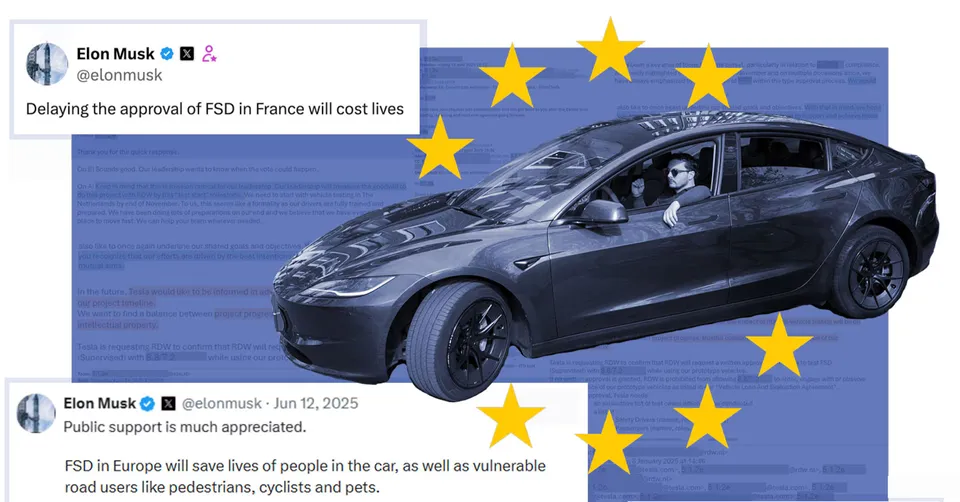
Tesla's campaign for European approval of its supervised Full Self-Driving system is becoming a major test of how regulators evaluate advanced driver assistance. The company argues that broader use can improve safety and has pressed national authorities to accelerate decisions. Critics say the evidence does not yet justify the claims and that public pressure risks weakening independent assessment. Despite its name, the system requires continuous driver attention. The dispute therefore concerns more than one product: it will help determine the standards Europe applies when software begins to make increasingly complex decisions on public roads.
Why Tesla EU Full Self-Driving Approval Matters
A national authorization can influence the wider European process because vehicle rules are coordinated across the bloc. Support from the Netherlands has created momentum toward a broader vote, while several countries have already permitted limited deployments. Approval would give Tesla access to a large market at a time when its European sales face stronger competition. It would also encourage rival manufacturers to accelerate similar systems. Regulators must balance innovation against the possibility that an inadequately tested feature is deployed at scale before its weaknesses are understood.
The central difficulty is measuring safety fairly. Companies often compare miles driven with assistance against broad crash statistics, but the conditions may not be equivalent. A system might be used mainly on newer roads, in good weather or by highly attentive enthusiasts. Professional test drivers also behave differently from ordinary owners. Researchers have questioned studies that rely on proxy behavior, such as horn use, rather than verified collisions and injuries. Without comparable exposure data, a lower incident rate can look persuasive while concealing important differences in route, speed and supervision.
Pressure Campaigns Can Complicate Technical Review
Tesla has mobilized supporters through social media and publicly criticized regulators for moving too slowly. Citizen engagement can be legitimate, but technical approvals should rest on transparent evidence rather than the volume of online demands. Officials need enough time, staff and independence to reproduce tests and examine raw data. When a company frames delay as a cause of preventable deaths, it places a heavy burden on agencies even though the claimed benefits remain disputed. That pressure can erode public trust regardless of the final decision.
Cost is another source of tension. Regulators have adjusted parts of their evaluation process after complaints about the expense of testing. Efficient review is desirable, but reduced cost should not mean weaker evidence. A better approach is to publish standardized scenarios, reporting definitions and pass thresholds before an application is assessed. Manufacturers could then design validation programs that generate comparable results, while independent laboratories verify performance. The same rules should apply to every company, preventing special treatment and making approval easier to defend.
Driver Monitoring Is as Important as Driving Performance
A supervised system can fail even when its steering and braking are technically capable because users misunderstand its limits. Repeated successful trips may encourage drivers to look away, use a phone or assume the car is fully autonomous. Effective monitoring should detect attention, not merely the presence of a hand on the wheel. Alerts must escalate quickly, and continued misuse should restrict access. Marketing language also matters. A product name associated with full autonomy can create expectations that conflict with instructions requiring constant supervision.
Europe Needs Real-World Post-Approval Oversight
No premarket test can reproduce every road, weather condition or human behavior. If approval is granted, regulators should require continuous incident reporting, access to relevant logs and rapid software correction when patterns emerge. Data should distinguish whether the system was active, whether it issued a takeover request and how the driver responded. Serious events need independent investigation rather than analysis controlled only by the manufacturer. A staged rollout with geographic and operational limits would allow authorities to learn before exposure becomes too large.
Software updates create an additional challenge because the product can change after approval. A new model may improve one behavior while introducing another weakness. Authorities must define which updates require fresh validation and how quickly older versions must be retired. Owners deserve clear release notes that explain safety-relevant changes in plain language. Treating the system like static mechanical equipment would miss the central feature of modern vehicles: performance is continuously altered by code and data.
Evidence Must Lead the Decision
Advanced assistance could reduce crashes if it is designed responsibly, understood by users and monitored after launch. The potential benefit does not remove the need for rigorous proof. European authorities should evaluate representative drivers, real collision outcomes and the system's response to rare but dangerous conditions. Tesla should receive a timely decision, but neither political urgency nor online enthusiasm should substitute for reproducible data. The credibility of future autonomous-driving regulation depends on showing that approval follows evidence and that safety obligations continue long after a feature reaches customers.
PUBLISHED
BY
SUYASH PACHAURI,
FOUNDER & OWNER,
GLOBAL BOLLYWOOD | THE HOLLYWOOD SCOPE