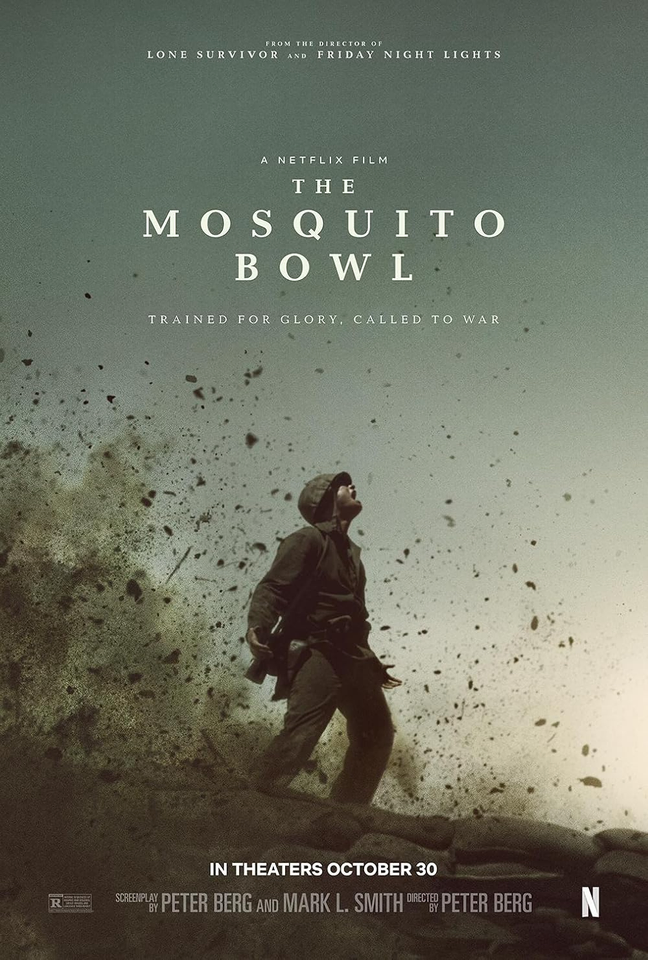
The Mosquito Bowl reaches its worldwide streaming premiere on November 25, 2026, after a theatrical opening and an unusually extensive series of previews for military communities and football audiences. The film, directed by Peter Berg and adapted from Buzz Bissinger's nonfiction book, links two institutions that rarely share the same dramatic stakes: collegiate sporting achievement and military service during the Second World War. A November 12 update about its Veterans Day screenings provided an important perspective on the production. Rather than treating the film as a routine period spectacle, the rollout has invited people closely connected with its subject matter to engage with the adaptation before a broader audience discovers it.
A Historical Story With a Different Kind of Sporting Stakes
The story begins after the attack on Pearl Harbor, when gifted American college football players step away from reputations that might have defined their futures. They enlist in the Marine Corps and eventually encounter a game whose meaning is inseparable from the prospect of combat. The football contest is not framed merely as a contest to be won. Its dramatic potential lies in how a group accustomed to rules, teamwork and the certainty of a scoreboard confronts situations that cannot be settled by a final whistle. That collision offers a different emotional foundation from a conventional underdog sports film.
For viewers unfamiliar with the events, the film takes its name from a football game played by servicemen in the Pacific during the war. The central figures are not fictional champions inserted into a historical backdrop for convenience. The adaptation draws on actual college athletes whose wartime experiences expose the fragility of sporting fame. The screenplay can therefore be approached through two questions: what does a person carry from an athletic identity into military life, and what remains when competition is replaced by responsibility to others? Those themes are relevant even when the viewer does not follow American football.
Why the November 12 Screening Update Matters
The November 12, 2026 account of the advance-screening initiative followed events organised around the Marine Corps birthday on November 10 and Veterans Day on November 11. Filmmaker Peter Berg and author Buzz Bissinger joined discussions with veterans and representatives of military organisations. A screening in Washington brought the film before audiences with a direct relationship to military service. Other programmes connected the story with universities and former service members. These were promotional appearances, but the choice of audience also made the discussions an opportunity to test how a film about sacrifice is received beyond the entertainment industry's usual premiere circuit.
More than 1,700 service members across ten military bases were given early opportunities to see the film. The locations included installations in Arizona, Hawaii, Mississippi, North Carolina, Virginia, Washington and California. The scale matters because war dramas can attract attention for battlefield spectacle while leaving the everyday experience of military communities underexplored. Advance screenings cannot establish a movie's historical accuracy by themselves, nor do they guarantee a particular critical response. They do, however, show a deliberate effort to put the story in conversation with people who may recognise its language, discipline and institutional culture.
The filmmaker's responsibility to real lives
A film based on identifiable historical individuals faces a harder task than simply reproducing uniforms and equipment. Choices about character motivation, dialogue and timing can shape how an audience understands the real people behind a story. Research provides facts, but dramatic construction determines which experiences become visible. The strongest approach acknowledges that courage is not a single pose or an uncomplicated statement of patriotism. It can involve uncertainty, grief, friendship and duties accepted without any guarantee of recognition. That is the lens through which the film's community screenings are most interesting.
Peter Berg, Buzz Bissinger and the Adaptation Challenge
Berg's previous work in sporting drama gives this material a recognizable creative connection, particularly because Bissinger's writing also informed Friday Night Lights. Yet this film must establish its own tone. A football field can be filmed as a place of precision, rhythm and common purpose, while a battlefield may contain confusion and irreversible consequences. If the film merely repeats the energy of a sports championship, it risks diminishing the circumstances surrounding the men. If it removes the sporting personalities entirely, it loses the specificity of why these athletes' choices are compelling. Balancing both worlds is the central adaptation challenge.
The account of the preview programme described visits to military institutions and conversations among the filmmakers, cast and service personnel. It also highlighted military advisers involved with practical preparation. Those details should not be confused with an independent certification of historical authenticity. They do suggest that the production placed value on the physical routines of the Marine Corps alongside the characters' emotional journeys. For an audience interested in craft, the intriguing question is whether the research survives into the finished scenes as behaviour and atmosphere rather than only as accurate-looking costumes.
The Four Leads and the Human Scale of the Film
Nicholas Galitzine, Bill Skarsgård, Ray Nicholson and Tom Francis lead the ensemble as the college athletes whose lives are transformed by service. Their collective casting creates room for contrasting temperaments rather than a single heroic viewpoint. The November preview accounts also identified the actors' participation in conversations with service members. This matters particularly for a film in which group identity is essential. War films often work best when individual personalities remain distinct inside a larger unit, allowing friendship to emerge through decisions, limitations and ordinary exchanges instead of speeches explaining the importance of brotherhood.
The preparation process drew on both football and military contexts. The cast engaged with professional sporting environments, while advisers introduced the movements and routines associated with Marine training. Such physical experiences can influence a performance in subtle ways: how a character carries equipment, responds to an instruction or moves alongside teammates. No amount of training replaces acting, and the completed movie must be judged on screen. Still, the preparation offers a useful production story because it joins the film's two worlds through the performers rather than asking the screenplay alone to create that connection.
College Football Organisations Enter the Conversation
The advance campaign also reached professional and collegiate football programmes, including several NFL teams and universities connected with the historical players. For these institutions, the story has meaning beyond sports nostalgia. It recalls a generation whose athletic careers were interrupted by a global conflict and prompts questions about the responsibilities that accompany public recognition. Events tied to those institutions should be dated clearly, not represented as new developments weeks after they happened. What remains valuable now is the contextual bridge they provide for viewers who may arrive at the film because of football rather than an interest in wartime history.
How the football story can reach international viewers
The film's global release creates an additional storytelling challenge. Audiences outside the United States may know little about collegiate football traditions, the schools involved or the significance of military rivalries. The screenplay must make relationships readable without relying on prior sports knowledge. A convincing account of personal sacrifice can cross cultural boundaries, but it still needs precise characters and situations to avoid becoming generic. The movie's appeal may therefore depend less on whether viewers understand an American football play than on whether they understand what the players have to lose.
Museums, Veterans and the Meaning of Public Memory
A preview at a military history museum placed the adaptation alongside institutions responsible for preserving records and interpreting the past. That context is worth distinguishing from ordinary marketing. Historical cinema can reach people who might never open a specialist history book, but the emotional force of a feature also creates an obligation to distinguish dramatic invention from documented events. Museum conversations offer one setting in which such distinctions can be discussed. Viewers should approach a narrative film as an interpretation of history and, if interested, explore the documented lives and sources beyond its final scene.
The preview programme provides evidence of an outreach strategy, not a measured account of audience sentiment. No verified survey has been presented here to show how veterans, students or football fans assessed the film. Similarly, the figure of more than 1,700 service members refers to reported advance attendance, not box-office demand or viewing figures. Keeping these categories separate is essential for responsible coverage. A past screening turnout must not be recycled as if it were a new audience milestone, and an emotional testimonial should not stand in for a general conclusion about historical accuracy.
The Release Calendar and What Is Confirmed
The Mosquito Bowl premiered at AFI Fest on October 22, 2026, followed by a limited United States theatrical opening on October 30. Its worldwide streaming availability is scheduled for November 25. Those dates describe separate stages of the same release, not three competing premiere announcements. The November 12 update concerns the advance community screenings and preparations leading toward that global streaming debut. It does not announce a new theatrical date, a changed cast or a fresh box-office record. Readers planning to watch should rely on the confirmed November 25 date rather than older promotional posts that refer only to early screenings.
At approximately two hours and eight minutes, the film has space to explore the movement from athletic life into military service, although running time alone cannot reveal the pace or depth of the narrative. The film's R rating in the United States also suggests that families should check the applicable local content guidance before watching. Availability can vary by region and parental-control settings. The relevant current information for late November is straightforward: the historical drama is approaching its streaming release, with Berg directing and Galitzine, Skarsgård, Nicholson and Francis among its principal performers.
Why the Story Remains Relevant Beyond Release Week
There is a broader question behind the publicity: how should popular cinema represent people whose lives were shaped by events far larger than any personal ambition? The college athletes in this story make a difficult transition from public recognition to military duty. A compelling film can illuminate that transition without treating it as an easy moral formula. The community screenings have highlighted conversations about service and remembrance, but the movie itself will ultimately need to earn its emotional claims through craft, perspective and restraint. Those are the measures that should guide a considered critical assessment after viewers have seen it.
For readers, this November retrospective offers a useful point of entry rather than a substitute for a review. The film's book origins, confirmed creative team, outreach to veterans, football connections and approaching release date are now established. Its performances, screenplay choices and historical interpretation deserve separate evaluation on the finished work. By distinguishing the events of November 10 to 12 from the November 25 streaming premiere, the story preserves the chronology and avoids presenting earlier publicity as a new development. The human questions behind the film are more enduring than the announcement cycle.
PUBLISHED BY SUYASH PACHAURI, FOUNDER & OWNER, GLOBAL BOLLYWOOD | THE HOLLYWOOD SCOPE.