FILM REVIEW
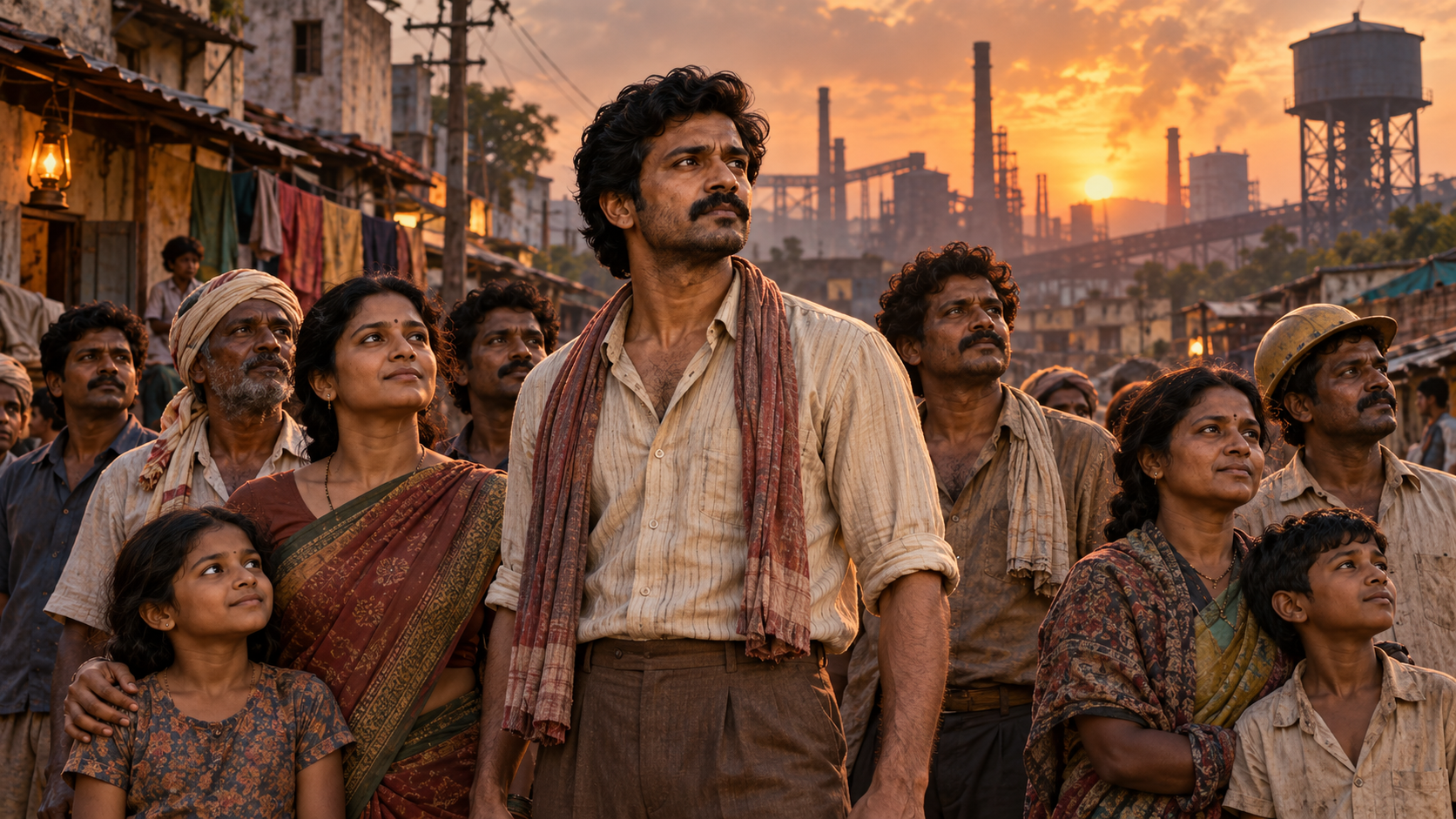
The Paradise is built on scale, anger and identity. Set in 1980s Secunderabad, it enters the lives of the marginalised Savari community, where dignity is not an abstract ideal but something negotiated every day under systems of hierarchy, violence and inherited humiliation. Srikanth Odela approaches the material as a period action drama with the emotional temperature of a rebellion. The production is large, the textures are dense, and the protagonist is introduced not as a spotless saviour but as a man returning from prison to a world that has changed while remaining painfully familiar.
Nani plays Jadal with an intensity that gives the film its centre of gravity. Around him stands a network of family, oppressors, allies and casualties: Mohan Babu's Malik represents entrenched power, Kayadu Lohar brings emotional immediacy, Sonali Kulkarni adds maternal and social weight, Raghav Juyal injects volatile hostility, and Sampoornesh Babu supplies an earthy presence. The Paradise has the confidence to create a world before it creates a clean plot. That is both its greatest strength and its major weakness. The film often feels alive in individual passages even when the larger narrative becomes overloaded.
Introduction
The story begins with Jadal returning from prison and re-entering the Savari settlement, a space shaped by labour, prejudice, community bonds and the control of powerful men. His return is not immediately framed as a heroic homecoming. He has anger, history and unfinished relationships. The screenplay uses his re-entry to reveal the social order around him. The community does not simply need a fighter; it needs a language through which it can imagine itself differently. Jadal becomes important because his personal refusal gradually connects with a collective refusal.
This is a familiar dramatic architecture, but Odela gives it local specificity through dialect, bodies, production design, clothing, sound and social behaviour. The Paradise is interested in who gets to occupy space, who must lower their gaze, who is permitted to speak and who is punished for doing so. These ideas are strongest when embedded in ordinary interactions. When the film shifts into declarative speeches and repeated demonstrations of oppression, its point becomes less powerful because the audience has already understood it. The film's best politics is visual and behavioural, not verbal.
Screenplay & Script Sense
The screenplay works in movements rather than a perfectly linear dramatic climb. The early sections establish community, Jadal's past, Malik's influence and the emotional ties that make rebellion costly. This patient world-building gives the action later in the film more meaning because the viewer understands what is being defended. The script also avoids making Jadal morally uncomplicated. His rage can be protective, destructive and self-serving within the same stretch of drama. That contradiction gives Nani useful material and prevents the protagonist from becoming a slogan.
The problem is accumulation. The Paradise wants to be a character study, a community chronicle, a revenge drama, a caste and class critique, a family tragedy, a political fable and a mass-action event. None of those ambitions is inherently misplaced, but the screenplay does not always decide which one should lead a particular sequence. Subplots enter with force and then recede. Supporting characters are introduced as though they will carry major emotional consequences, only to become functional later. The nearly three-hour running time feels justified in some world-building passages and excessive in others.
The writing is strongest when cause and effect remain personal. A humiliation leads to a decision, a family memory changes how Jadal responds, or a small act of cruelty reveals the larger social structure. It weakens when the narrative begins to stack provocations simply to keep the emotional temperature high. Constant intensity can flatten impact. A film needs valleys so that its peaks matter. The Paradise sometimes mistakes escalation for progression, especially in the middle stretch where confrontations begin to echo one another.
The final movement delivers the expected collision between individual vengeance and collective assertion, but the route to that collision is more complicated than necessary. Some revelations arrive late, some emotional beats deserve more preparation, and certain secondary motivations remain thin beside the enormous visual treatment. A sharper screenplay would not require a smaller film. It would simply align the large canvas around fewer, stronger emotional lines.
Direction
Srikanth Odela directs with physical confidence. He likes faces marked by sweat, dust, injury and suppressed emotion. He also understands the mass potential of Nani without turning every scene into a star vehicle. Several of Jadal's strongest moments are built through stillness before eruption. Odela's camera and staging frequently place the protagonist inside the community rather than above it, which supports the film's central idea that leadership emerges from shared humiliation rather than divine entitlement.
Odela is equally comfortable with brutality and pageantry, though the balance is not always ideal. The larger action passages are mounted with conviction, and the director has an instinct for entrances, pauses and explosive release. At times, however, stylistic emphasis becomes so heavy that emotional meaning has to fight through technique. Slow motion, sound surges, symbolic framing and repeated reaction shots can turn a raw moment into a designed moment. The Paradise is more moving when the director trusts actors and spaces than when he tells the audience exactly how monumental a scene should feel.
Acting
Nani delivers a physically committed and emotionally restless performance as Jadal. He changes his posture depending on whether the character is among his own people, facing authority or alone with memory. The performance carries anger without becoming one-note because there is shame, tenderness and calculation underneath it. His voice work is especially effective in the quieter exchanges where resentment is controlled rather than released. In action, he has the required force, but the more impressive achievement is how he makes Jadal's violence feel connected to accumulated experience rather than merely to star image.
Mohan Babu gives Malik the weight of someone who has exercised power long enough to consider it natural. The performance is not built on constant shouting. His most effective scenes are those where contempt is casual, almost administrative. That makes the character more disturbing because oppression appears routine rather than exceptional. When the screenplay pushes Malik toward broader villainy, Mohan Babu's authority keeps the role from becoming cartoonish.
Kayadu Lohar brings warmth and emotional clarity to Subbalakshmi. Her presence matters because the film can otherwise become dominated by male rage and political confrontation. She gives personal stakes to choices that might have remained ideological. Sonali Kulkarni, as Sammakka, carries history in her face and voice. She is particularly strong when the character's protective instincts conflict with the knowledge that survival itself can demand compromise. The film could have used even more of her interiority.
Supporting Cast
Raghav Juyal, making a striking Telugu turn as the antagonistic Vikram Malik, uses unpredictability as his principal weapon. His physicality is loose, his expressions can shift quickly from amusement to threat, and he avoids simply reproducing his earlier villainous mannerisms. The dubbing and language effort do not appear to inhibit his energy. The role is written aggressively, but Juyal finds flashes of insecurity that make the hostility more interesting.
Sampoornesh Babu as Biriyani contributes humour, earthiness and community texture without reducing the film's seriousness. Keerthy Suresh, associated with the role of Bujjavva, gives emotional resonance where the narrative permits it. Easwari Rao, Tanikella Bharani, Raja Ravindra, Ram Jagan, Babu Mohan, Priyadarshi as MLA Shankaranna and the broader ensemble build the social field around Jadal. Lavanya Sahukara's younger Sammakka connects generational memory to the present. Not every supporting arc receives equal development, but the ensemble prevents the settlement from feeling like a background set built solely for the hero.
Cinematography
Ch Sai's cinematography is fundamental to the film's world. The images make the settlement feel tactile, crowded and historically specific. Earth tones, smoke, industrial surfaces, cramped lanes and open spaces are used to show social hierarchy as much as geography. The camera often stays close to bodies during conflict, making violence feel immediate, then opens wide during community gatherings to show the scale of collective feeling. This movement between intimate and epic is one of the film's most effective visual strategies.
The action photography is muscular without always becoming chaotic. There are moments of stylisation, but the best sequences preserve a sense of weight. Injuries look painful, spaces have boundaries, and bodies do not seem to float free of physical consequence. Some frames are designed for instant iconography, and a few feel too consciously composed, but the overall visual achievement is substantial. Even when the screenplay becomes congested, the cinematography keeps the world legible.
Music & Background Score
Anirudh Ravichander's music understands that The Paradise needs rhythm as much as melody. The songs and score work with percussion, chant-like energy and recurring motifs to reinforce the community's pulse. The mass numbers are engineered for theatrical response, but the more interesting work occurs when music grows out of environment rather than being placed on top of it. Anirudh gives Jadal sonic identity without making every appearance sound identical.
The background score occasionally pushes too hard, particularly in scenes that already contain strong performances and visual tension. Silence would have made some confrontations more dangerous. Yet the score also provides cohesion to a film moving across several tonal registers. It can shift from mournful memory to rebellion and action without losing its basic musical identity. In a film this large, that connective function is valuable.
Editing
Naveen Nooli faces the difficult job of organising a long, densely populated film whose energy is intentionally aggressive. Many individual sequences are cut with excellent internal rhythm. Entrances land, action geography remains understandable, and reaction shots are used to extend emotional impact. The editor also gives certain performances enough duration to breathe, particularly Nani and Sonali Kulkarni in quieter moments.
The larger structural edit could be tighter. Repeated demonstrations of power, secondary confrontations and transitional passages add length without always adding new information. The film would gain force by trimming repetition rather than reducing world-building. A shorter middle section could make the final movement feel more inevitable. The Paradise does not necessarily need to become a compact film, but it needs a clearer sense of which scenes are essential and which simply restate an already established emotional fact.
Final Verdict
The Paradise is an ambitious, imperfect and often arresting period action drama. It creates a world that feels larger than its plot, and that is a compliment until the plot begins struggling to contain the world. Nani gives the film a powerful centre, Mohan Babu supplies institutional menace, Kayadu Lohar and Sonali Kulkarni give the story emotional texture, Raghav Juyal brings volatile danger, and the ensemble helps the Savari community feel inhabited rather than symbolic.
The film's weaknesses come from excess rather than lack of effort. It has too many emphases, too many peaks and too many narrative obligations. Srikanth Odela's direction is confident, Ch Sai's images are memorable, Anirudh's score has theatrical force, and the craft departments build a persuasive period environment. With a more selective screenplay and tighter middle, The Paradise could have converted its impressive ingredients into a truly overwhelming experience. As it stands, it is a film whose ambition is visible in nearly every frame, even when that ambition becomes difficult to control.
On the Plus Side
Nani's performance is the clearest positive, but the achievement extends beyond the star. The world-building, period detailing, cinematography, production scale and community casting create density. Mohan Babu's authority gives the conflict weight, Sonali Kulkarni brings gravitas, Kayadu Lohar provides emotional accessibility, and Raghav Juyal adds a dangerous unpredictability. The action has physical impact and the music understands the theatrical grammar of the material.
The film also deserves credit for placing questions of dignity, social exclusion and collective memory inside a mainstream action structure without completely flattening them into slogans. Some scenes communicate hierarchy through a look, a seating arrangement or a physical boundary rather than through a speech. Those are the moments when The Paradise feels most mature and most original.
On the Minus Side
The principal drawback is overloading. Too many characters, conflicts and emotional registers compete for dominance. The running time magnifies repetition, while the score and visual style sometimes emphasise scenes that are already strong enough. Some supporting characters promise deeper arcs than the screenplay eventually provides. The film can therefore feel simultaneously rich and underdeveloped, because it has many ideas but unequal space for each.
The climax and late narrative turns would benefit from cleaner preparation. The movie's political and emotional arguments are strongest when embodied in character behaviour and weakest when verbalised repeatedly. A firmer edit, fewer repeated confrontations and a more disciplined hierarchy of subplots would make the same story substantially more powerful.
Best Catchy One Liner
The Paradise builds a thunderous world around Nani, but its biggest battle is with the weight of its own ambition.
FILM REVIEW BY
SUYASH PACHAURI
GLOBAL BOLLYWOOD
DIRECTOR’S DAILY CLAPBOARD
ONE LINER: Nani gives The Paradise a beating heart and Srikanth Odela gives it a world, but the film's enormous ambition often runs faster than its screenplay can organise.
PUBLISHED BY SUYASH PACHAURI, FOUNDER & OWNER, GLOBAL BOLLYWOOD | THE HOLLYWOOD SCOPE