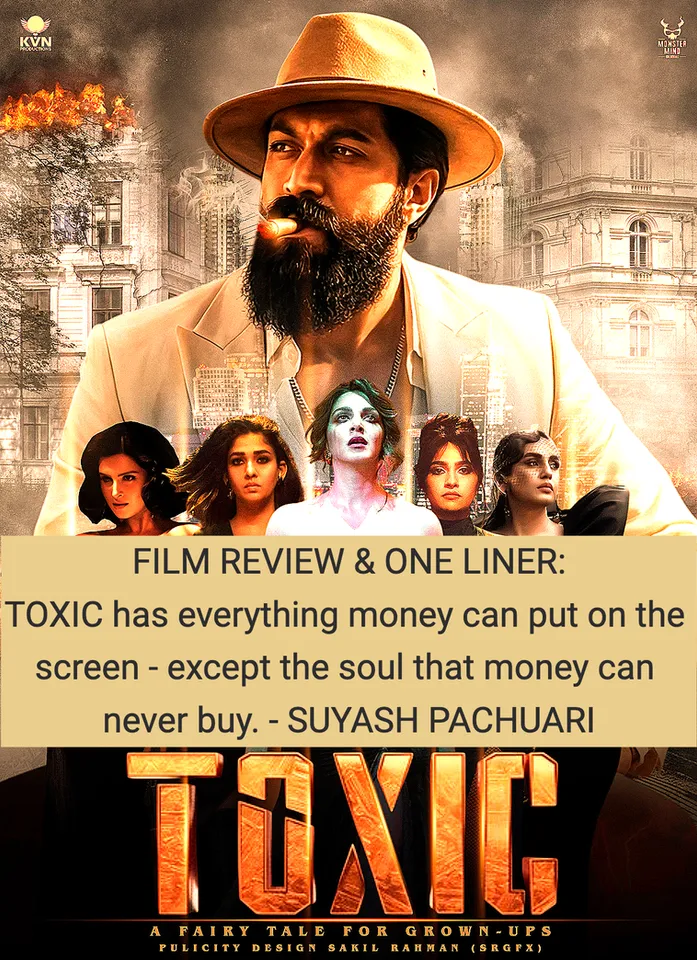
FILM REVIEW
Introduction
After the phenomenal impact of KGF and KGF: Chapter 2, Yash returns to the big screen carrying expectations that very few Indian stars have to shoulder. Unfortunately, Toxic: A Fairy Tale for Grown-Ups turns that anticipation into an exhausting cinematic experience.
Directed by Geetu Mohandas, Toxic wants to be dark, provocative, stylish, violent, unconventional and larger than life all at the same time. The problem is that underneath this mountain of ambition, there is surprisingly little storytelling capable of holding everything together.
The film repeatedly seems convinced that scale automatically creates impact. It doesn't.
For me, this is the weakest and most disappointing film of Yash’s career, particularly considering the extraordinary platform from which he was returning. There are flashes of technical brilliance and Yash still possesses tremendous screen presence, but neither is enough to rescue a film that becomes increasingly self-indulgent, overlong and emotionally distant.
Toxic looks expensive. It looks ambitious. At times, it even looks spectacular.
But a film ultimately has to feel something beyond its production value and that is precisely where Toxic struggles.
Screenplay & Script Sense
This is where Toxic suffers its biggest damage.
The screenplay, credited to Geetu Mohandas and Yash, tries to construct an enormous gangster universe around violence, family, betrayal, power, relationships and generational conflict. But instead of developing these elements organically, the film keeps piling one layer over another.
Characters arrive. Conflicts emerge. Guns fire. People betray each other. Yash makes another stylish entrance.
Yet the screenplay rarely gives the audience enough emotional breathing space to become genuinely invested in what is happening.
The biggest mistake is confusing complexity with depth.
A complicated narrative is not necessarily an intelligent narrative. There are portions where Toxic feels as though several potentially interesting films have been forced into a single screenplay.
Even the father-son dimension, which could have become the emotional backbone of the story, does not receive the consistent dramatic development it deserves.
The film desperately wants every dialogue, entrance and confrontation to feel iconic. But when everything is designed as a "moment," eventually nothing feels like a moment.
A stronger screenplay would have removed substantial narrative clutter, concentrated on fewer characters and allowed its central relationships to breathe.
Instead, Toxic becomes overloaded with its own ambition.
Direction
Geetu Mohandas is unquestionably an interesting filmmaker, and her transition into such gigantic commercial territory was one of the most fascinating aspects of Toxic. But ambition and execution are two completely different things. There are individual sequences where her visual command is impressive, with the atmosphere, staging and darkness occasionally suggesting the distinctive gangster epic Toxic could have become.
Unfortunately, the direction repeatedly becomes consumed by style rather than storytelling. Slow motion, attitude, violence, provocative imagery, dramatic framing and grand entrances often begin replacing narrative substance instead of complementing it. The other major concern is tonal control, as the film struggles to maintain a consistent balance between its dark dramatic ambitions and its larger-than-life commercial treatment.
Toxic attempts to combine the emotional complexity of an auteur-driven drama with the whistles, spectacle and hero worship of a massive commercial entertainer. These two cinematic languages can certainly coexist, but they demand exceptional control; here, they frequently work against each other, turning what could have been Geetu Mohandas’ spectacular mainstream reinvention into an example of cinematic ambition overpowering narrative discipline.
Acting
Yash is unquestionably the film’s biggest strength. His charisma, swagger and ability to dominate the frame remain firmly intact, but Toxic also demonstrates the important difference between screen presence and character development. Yash can make an entrance electrifying simply through his body language and attitude, yet the screenplay depends far too heavily on that established strength. After KGF, audiences already know that Yash can command the screen; the real challenge was to reveal a different and deeper dimension of him.
There are moments when his performance attempts to move beyond the superstar persona, particularly through the film’s emotional and generational conflicts, but these opportunities are repeatedly interrupted by the movie’s obsession with spectacle. The dual-role concept gives Yash potentially exciting territory to explore as a performer, yet the writing does not fully extract the dramatic possibilities of the idea or allow those contrasting dimensions to develop with enough depth.
Yash performs with conviction, but unfortunately, the film surrounding him never displays the same conviction about what it actually wants to be. That perhaps becomes the biggest disappointment of Toxic. A star capable of carrying a film of this enormous scale deserved a screenplay equally capable of carrying him.
Supporting Cast
Yash is unquestionably the film’s biggest strength. His charisma, swagger and ability to dominate the frame remain firmly intact. Toxic, however, also demonstrates the important difference between screen presence and character development. Yash can make an entrance electrifying simply through his body language and attitude, but the screenplay depends far too heavily on that established strength.
After KGF, audiences already know that Yash can walk into a frame and command it effortlessly. The real challenge with Toxic was to reveal a different and deeper dimension of him as an actor.
The dual-role concept gives Yash potentially exciting territory to explore as a performer, yet the writing does not fully extract the dramatic possibilities of the idea. Instead of allowing those contrasting dimensions to develop with greater emotional and psychological depth, the film repeatedly returns to swagger, scale and hero-elevation moments.
That perhaps becomes one of the biggest disappointments of Toxic.
Cinematography
If Toxic has one department that consistently reflects its enormous cinematic ambition, it is the visual presentation. Rajeev Ravi’s cinematography gives the film texture, scale and atmosphere, photographing its gangster world with remarkable confidence. Certain frames are so visually striking that they could almost be lifted from the film and displayed independently as posters.
And therein lies an accidental summary of Toxic itself: too many beautiful frames and not enough beautiful storytelling connecting them. The production design, lighting, locations and camera work combine to create an undeniably premium theatrical experience, demonstrating the scale and technical craftsmanship behind the film.
Technically, Toxic frequently looks magnificent; narratively, however, those impressive images often become decoration around an increasingly hollow centre. Great cinematography can elevate storytelling, but it can never substitute for storytelling.
Music & Background Score
The background score works overtime trying to manufacture intensity. There are sequences where the music genuinely elevates Yash’s presence and strengthens the atmosphere, but the constant insistence on making almost everything sound monumental eventually becomes tiring. Silence is also cinema, and unfortunately, Toxic rarely seems comfortable trusting it.
Every entrance doesn’t require thunder, every confrontation doesn’t need musical punctuation, and every emotional moment doesn’t need to announce that it is emotional. The music certainly has scale and power, but the film could have benefited enormously from greater restraint, allowing the score to enhance the drama rather than constantly dictate its intensity.
Editing
Editing is another major weakness. At approximately three hours and fourteen minutes, Toxic demands a considerable investment from its audience. Length itself isn’t necessarily the problem some of cinema’s greatest films are long. Feeling long is the problem, and Toxic frequently does. Its pacing fluctuates between frantic and strangely sluggish, preventing the narrative from finding a consistently engaging rhythm.
Some sequences are cut so aggressively that emotional continuity suffers, while elsewhere scenes continue considerably beyond the point at which their dramatic purpose has already been communicated. The film needed a much sharper editorial approach: remove the repetition, reduce the stylistic indulgence and give genuinely important emotional moments more breathing space.
A tighter Toxic could have been a dramatically different cinematic experience. Several portions primarily reinforce aspects of the protagonist that the audience already understands, adding length without enough narrative value. Instead of strengthening the film, the enormous runtime ultimately magnifies many of the screenplay’s existing weaknesses.
Final Verdict
Toxic: A Fairy Tale for Grown-Ups is perhaps one of the clearest examples of how bigger cinema doesn’t automatically mean better cinema. It has a superstar, enormous production values, beautiful cinematography, an extraordinary ensemble, violence, attitude, action, scale and ambition. What it desperately needed, however, was simplicity, emotional clarity and screenplay discipline. For Yash, this feels particularly disappointing because KGF: Chapter 2 left him standing at an extraordinary point in Indian popular cinema, and his comeback needed either an exceptional commercial entertainer or a genuinely daring reinvention. Toxic tries to become both but ultimately becomes neither completely.
Yash remains magnetic enough to survive much of the chaos surrounding him, and there are individual sequences genuinely worthy of applause. But a handful of powerful moments cannot compensate for an exhausting screenplay and an inconsistent narrative. For me, Toxic stands as the weakest film of Yash’s career not because Yash has suddenly lost his power as a performer, but because the film surrounding that power repeatedly mistakes swagger for substance, scale for storytelling and excess for entertainment.
After such a long wait, the biggest disappointment isn’t that Toxic takes risks; ambitious cinema should take risks. The disappointment is that underneath all those risks, money, scale, spectacle and ambition, there was potentially a far better film waiting to be discovered. Toxic had almost everything required to become a landmark cinematic experience, except the narrative discipline needed to bring all those elements together.
On the Plus Side
Yash's commanding screen presence
Impressive cinematography
Grand production design and visual scale
Strong technical craftsmanship in several action portions
An exceptionally talented ensemble cast
Some genuinely striking individual sequences
Ambition to create something beyond a conventional gangster entertainer
On the Minus Side
Weak and overloaded screenplay
Excessive runtime
Uneven pacing
Style repeatedly overpowering substance
Insufficient emotional connection
Too many characters and competing narrative threads
Repetitive hero-elevation moments
Excessive dependence on violence and visual spectacle
Supporting talent not utilised to its full potential
Frantic editing in important portions
Lack of narrative simplicity
A potentially powerful emotional story buried beneath cinematic excess
One Liner
“TOXIC has everything money can put on the screen - except the soul that money can never buy.”
PUBLISHED BY SUYASH PACHAURI, FOUNDER & OWNER, GLOBAL BOLLYWOOD | THE HOLLYWOOD SCOPE