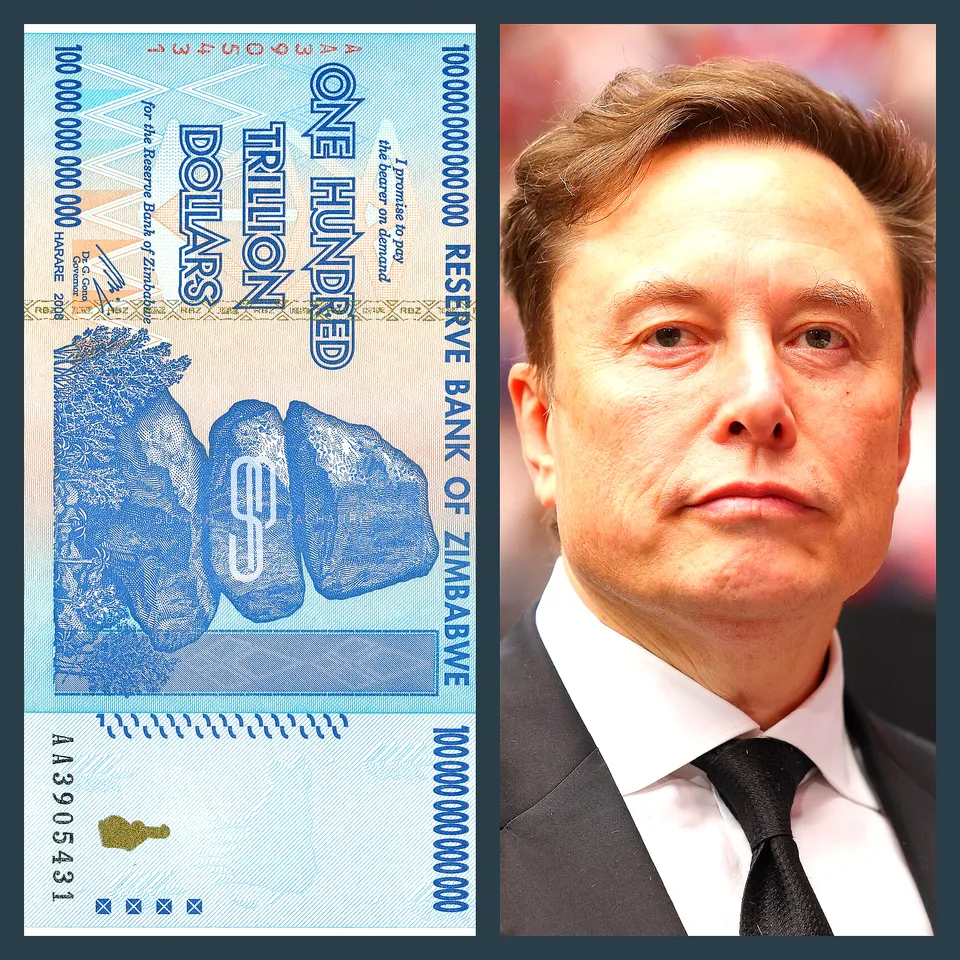
The word "trillion" carries extraordinary weight. Yet history has shown us that the same number can represent two completely different realities.
In 2026, entrepreneur Elon Musk reached a milestone that many once believed was impossible becoming the first individual in history to achieve a US$1 trillion net worth. It is a landmark associated with decades of entrepreneurship, technological innovation, calculated risk-taking, and the growth of companies that have reshaped industries ranging from electric vehicles and space exploration to artificial intelligence and digital infrastructure.
At the other end of history stands Zimbabwe.
Zimbabwe became globally known for issuing a 100 trillion Zimbabwean dollar banknote during one of the worst hyperinflation crises ever recorded. Although the note carried an enormous face value, it did not represent immense wealth. Instead, it reflected the collapse of the country's currency, where prices rose so rapidly that increasingly larger denominations had to be printed simply to keep up with everyday transactions.
This is what makes these two stories so fascinating.
One trillion represents the creation of economic value.
The other represents the destruction of purchasing power.
One story celebrates entrepreneurship, innovation, and long-term wealth creation.
The other serves as a powerful reminder of the devastating effects of hyperinflation on an economy and the daily lives of its citizens.
At first glance, both stories seem connected by the same number. But numbers alone never tell the full story. Context does.
Elon Musk's achievement, if viewed through the lens of business history, reflects decades of building companies that transformed global industries and attracted enormous market value. Whether admired or criticised, his entrepreneurial journey has become one of the defining business stories of the 21st century.
Zimbabwe's famous 100 trillion dollar banknote, meanwhile, has become a historic economic artifact. Today it is collected around the world not because it represents wealth, but because it symbolises one of history's most dramatic examples of hyperinflation.
These two milestones remind us that the value of money is never determined by the number printed on a banknote. Real wealth is measured by purchasing power, productive assets, innovation, and sustainable economic value.
The word "trillion" appears in both stories, but history will remember them for entirely different reasons.
One became the world's first individual trillionaire.
The other became the country remembered for issuing one of the largest-denomination banknotes ever circulated.
Same number.
Completely different legacy.
PUBLISHED BY SUYASH PACHAURI, FOUNDER & OWNER, GLOBAL BOLLYWOOD | THE HOLLYWOOD SCOPE