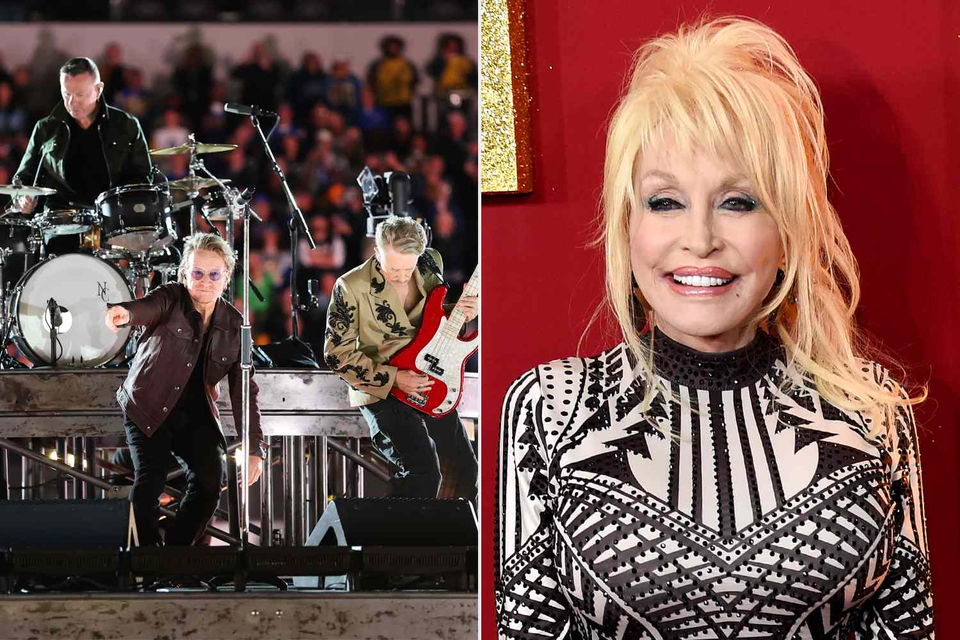
U2 transformed the NFL's first Thanksgiving Eve halftime show into a tribute to Dolly Parton, combining Bono's live performance with the country legend's final recorded vocal. The moment took place at SoFi Stadium during the Los Angeles Rams game against the Green Bay Packers and reached viewers through a live Netflix stream.
The centrepiece was "Torn," a song from U2's album Carnaval De Luz. Parton's voice played as Bono sang onstage, while images of her surrounded the performance space. The staging connected a large sports broadcast with a deeply personal musical farewell, giving the recording a public life beyond the album on which it appears.
How the U2 Dolly Parton Tribute Unfolded
The band opened its short set with songs closely associated with its public identity. "Sunday Bloody Sunday" brought a forceful rhythmic entrance, while "Pride (In the Name of Love)" carried the kind of large-scale chorus suited to a stadium. "Torn" was the only selection from the new album, and its emotional context made it the defining part of the appearance.
Bono performed against Parton's prerecorded vocal rather than presenting the track as a conventional live duet. Her image was projected around the stage, making the absence visible rather than disguising it. That choice gave the performance the character of a memorial without turning it into a formal ceremony.
The setting also carried historical weight for U2. The group previously performed at the Super Bowl halftime show in 2002, when its set became one of the most remembered stadium performances of the period. Returning for the first Thanksgiving Eve game placed the band inside another first for the league, this time in a media environment shaped as much by streaming as traditional television.
Why "Torn" Carries Exceptional Meaning
Parton recorded her contribution in Nashville in June. It became her final recorded vocal before her death at the age of 80 in August. That chronology changes how the song is heard. What began as a collaboration now serves as one of the last additions to a career that crossed country, pop, film, philanthropy and public life.
The song was written by U2, Parton and Snow Patrol musician Johnny McDaid. Jacknife Lee produced it, and Daniel Lanois contributed pedal steel, adding a country texture to the band's established sound. The arrangement creates a meeting point between U2's expansive rock style and the clarity of Parton's storytelling tradition.
Lyrically, "Torn" addresses a household divided by beliefs and the struggle to break inherited cycles of conflict. That subject gave Bono room to frame Parton's legacy around empathy and her ability to connect people with different political or cultural identities. The message was especially resonant during a holiday broadcast built around a shared national occasion.
A Music Event Designed for Streaming
The performance was not simply a concert inserted into a football game. It was part of a wider shift in which streaming platforms use live sport to create entertainment moments that travel beyond the match itself. Netflix carried the game, allowing the halftime appearance to reach music fans who may not otherwise follow the Rams or Packers.
For the NFL, the first Thanksgiving Eve game created another premium event around a holiday already associated with football. For Netflix, the combination of sport, a globally recognised band and a tribute to an American music icon offered several audiences one reason to watch at the same time.
The result also demonstrates why halftime programming matters to artists. A compact set can introduce a new album track to an audience far larger and more varied than a standard promotional appearance. In this case, however, promotion was secondary to remembrance. "Torn" arrived with an emotional history that could not be separated from the public response.
Dolly Parton's Voice Remains at the Centre
Parton's final recording is significant because her career was built not only on vocal recognition but also on authorship. She wrote songs that travelled across genres and generations, often combining direct language with complicated emotional choices. Her participation in "Torn" extends that tradition into a collaboration that addresses division, family and reconciliation.
The halftime staging respected that contribution by keeping her voice central. Bono did not imitate or replace her part. He performed with it, allowing the recording to remain distinct. The projected images reinforced the idea that the audience was hearing a specific artist whose presence could still shape the room.
U2's other selections provided scale, but "Torn" provided the reason the performance will be remembered. It brought a newly released song into a setting normally dominated by familiar hits and connected it to a loss still recent for fans.
What the Performance Adds to Both Legacies
For U2, the appearance linked the band's long history of stadium performance with a new album and a streaming-era sports event. For Parton, it offered another public setting in which her final recorded work could be heard as a living collaboration rather than an archival footnote.
The tribute succeeded because it did not depend on spectacle alone. Its power came from the contrast between a packed stadium and one irreplaceable recorded voice. By placing that voice inside the first Thanksgiving Eve NFL halftime show, U2 gave "Torn" a cultural moment equal to its emotional weight.
PUBLISHED BY SUYASH PACHAURI, FOUNDER & OWNER, GLOBAL BOLLYWOOD | THE HOLLYWOOD SCOPE.