Two November Awards With Long-Term Consequences
On 11 November 2026, the British Film Institute confirmed two public investments designed to help independent filmmakers test emerging technology responsibly. The National Film and Television School received £400,000 and Falmouth University received almost £250,000. These awards support two-year research and training programmes, not immediate unrestricted production grants for every filmmaker. Their lasting significance lies in structured experiments, practical guidance and evidence that smaller teams can use before choosing expensive or legally complicated tools.
Both awards came through the sixth Innovation Challenge Fund call, known as In Our Hands. The initiative addresses access to artificial intelligence, virtual production and new capture methods. In an independent production environment, access alone is not sufficient. Teams need to understand how much a workflow actually costs, whether the output can be reproduced and what permissions are needed. A technically impressive demonstration can still be unsuitable for a feature film if its rights position, reliability or staffing demands remain unclear.
How the Two Programmes Differ
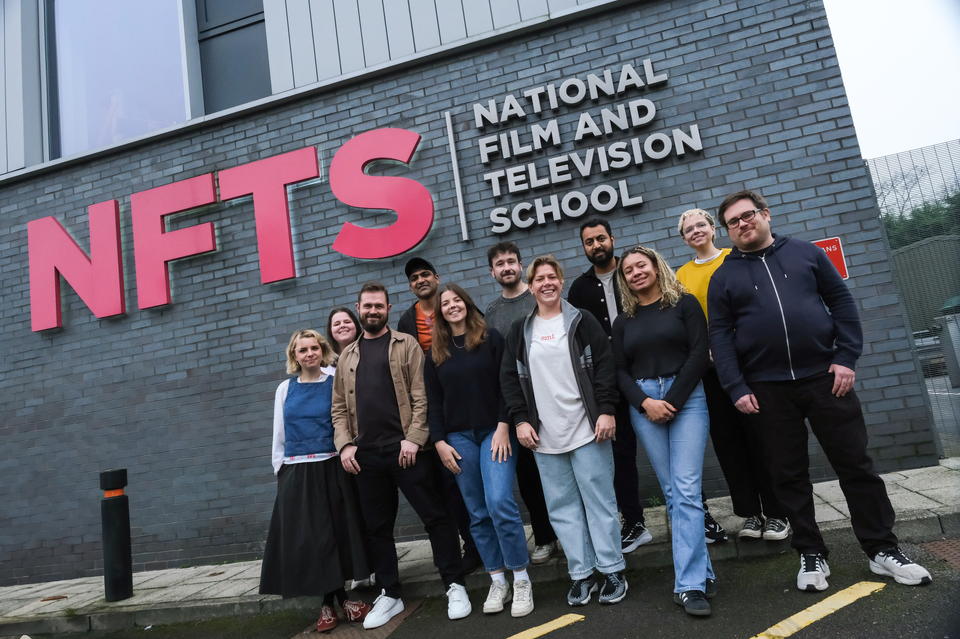
National Film and Television School innovation pipeline
The £400,000 school programme is called NFTS x BFI Innovators. It combines consultation with working professionals, research, skills development and funded creative experimentation. A selected cohort of ten practitioners is expected to develop proof-of-concept projects. That number describes the intended final supported group, not the total number of professionals who may benefit from wider learning activities. A proof of concept can help a director or producer test a difficult technique before investing in a full-length sequence.
The strongest experiments should document more than an attractive final image. Preparation time, specialist equipment, software costs, crew training, revision cycles and unexpected failures all matter. When published, these records can help other filmmakers decide whether a technique is realistic for a low-budget project. The original 11 November announcement did not establish an open application deadline for this programme, so readers should not assume the ten places are available through a general public form.
Falmouth University's practical AI laboratory
Falmouth's nearly £250,000 award supports Lab to Slate, a focused experiment in the safe and responsible use of AI across screen production. Eight independent creatives are intended to work with mentors, tools and legal and ethical guidance while exploring systems within their existing projects. The structure places practical creative decisions ahead of generic claims about speed or efficiency. Research generated by real productions can expose limitations that are easy to miss in carefully controlled technology demonstrations.
Both programmes promise to share findings with a wider audience. Falmouth has described an open-access AI Production Playbook that can include lessons about unsuccessful trials as well as successful ones. Independent filmmakers may benefit more from knowing why a technique failed, required an unexpected licence or needed additional human supervision than from another showcase image. No final publication date for the planned playbook was established in the 11 November award announcement.
A Later Application Opportunity, Clearly Dated
An 18 November 2026 Falmouth University update, published after the historical period covered by this recovery, confirms applications for eight Lab to Slate participants. It gives a deadline of midday on Monday 7 December 2026. Eligible applicants include UK-based independent creatives with scripted or documentary projects in development. The programme is primarily remote, and previous AI experience is not required. This later update is included for current usefulness and must not be confused with the original 11 November funding announcement.
According to the programme details released on 18 November, each participant can receive an annual bursary of £2,500, alongside mentoring, training and access to tools. Activities address intellectual property, business affairs and environmental impacts. Applicants retain creative control and ownership of their projects under the programme's stated arrangements. Filmmakers should check the organiser's complete terms before applying, particularly the geographical eligibility, project requirements, expected research participation and permitted use of project material.
Rights, Privacy and Creative Control
Preparing a reliable rights record
An AI-assisted workflow can touch scripts, character artwork, actors' performances, voice material and confidential development documents. Producers should record which assets enter an external system, who approved their use and which contractual restrictions apply. They also need to understand whether output may be used commercially, whether any vendor retains project material and whether a tool permits inputs to be used for model improvement. These questions are not solved simply by paying a software subscription.
The same care applies to performers and crews. A voice replication, digital likeness or altered performance can create obligations that are separate from the ownership of the underlying film. Even where a tool works reliably, a distributor or insurer may require a clear chain of title and documentation of permissions. Early experiments are the right point to create repeatable internal practices, so that a final production does not inherit unexamined legal or privacy risks.
Determining real production value
The economic case for new tools should include training, revisions, quality checks, specialist equipment and the time needed to integrate results with conventional footage. Virtual stages can require experienced technicians; automated image generation can create continuity problems; and a cheaper prototype may need costly clean-up. These are reasons to measure each workflow carefully, not reasons to dismiss innovation. Good research helps filmmakers choose methods that serve a director's vision without hidden expenses.
Creative judgement remains essential. Cinematographers, designers, editors and production managers are often the people best equipped to identify a tool's flaws or find a worthwhile new use for it. Research programmes should therefore examine how technology changes collaboration rather than only how many tasks it can automate. The objective is a more informed production culture in which smaller companies can make deliberate choices instead of responding to advertising pressure.
What Independent Filmmakers Can Take Forward
The announced awards are specifically directed toward the United Kingdom's independent screen sector. A filmmaker based elsewhere should not interpret the investment as proof of eligibility for a supported place. International professionals may nevertheless learn from the public resources planned by the programmes, then consider how their findings apply under local copyright law, crew agreements and production budgets. Cross-border partnerships or applications need separate confirmation from the organisers.
The November decision is important because it treats technological experimentation as a question of evidence and responsibility. The school programme will test new creative methods through a limited proof-of-concept cohort, while Falmouth's separate initiative explores AI directly with independent filmmakers. As both initiatives progress over two years, their real value will depend on honest documentation of cost, access, artistic quality and legal obligations. This is a continuing industry development, not a breaking announcement.
PUBLISHED BY SUYASH PACHAURI, FOUNDER & OWNER, GLOBAL BOLLYWOOD | THE HOLLYWOOD SCOPE.