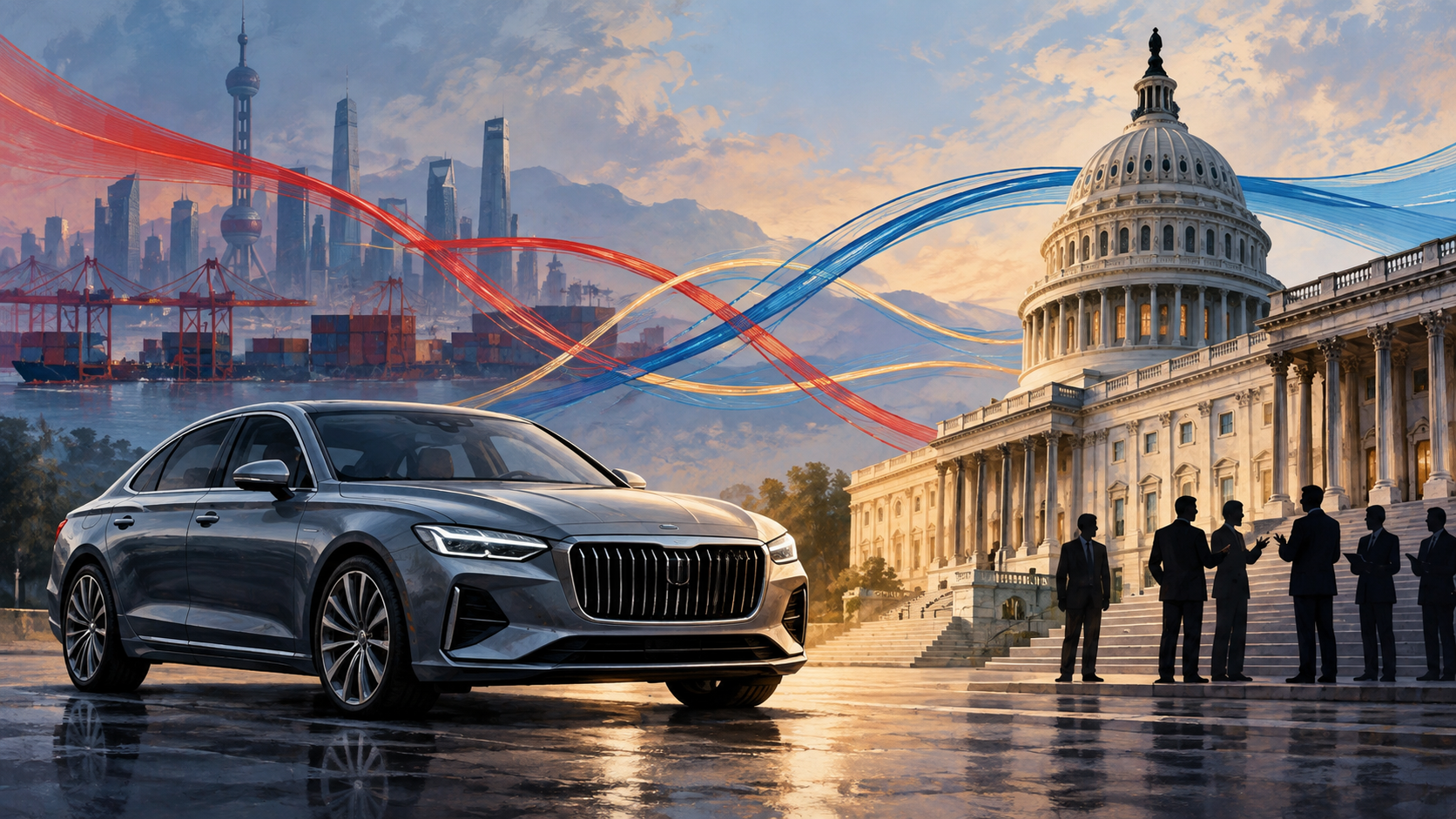
A proposed US restriction on Chinese-linked vehicle ownership has created an awkward question for Mercedes-Benz: how should a law distinguish a company's nationality, its shareholders and control over its operations? On September 29, Senator Bernie Moreno said discussions were continuing to prevent the proposal from banning Mercedes-Benz vehicles. The committee-approved measure uses a threshold above 15% Chinese ownership, while the German manufacturer has nearly 20% passive Chinese ownership. The development concerns proposed legislation and negotiations over its scope. It does not mean a new Mercedes-Benz sales ban has taken effect.
A threshold with consequences beyond its original target
Ownership thresholds appear straightforward because they reduce a complex corporate structure to a measurable number. In practice, a percentage can conceal important differences. A shareholder may possess voting rights, board influence or a purely financial interest. Several investors may act independently or in concert. A rule built around aggregate ownership therefore needs definitions that explain what is being counted and why. Without that clarity, businesses cannot reliably assess whether their structure creates a compliance problem.
The Mercedes-Benz debate illustrates the difficulty of designing national-security restrictions for an interconnected industry. A car can be engineered in one country, assembled in another and sold through a network financed by investors elsewhere. Its software and components may introduce additional relationships. None of this makes security concerns irrelevant. It does mean that legislation needs to identify the risk it intends to address and connect the chosen restrictions to that risk in a way that companies and regulators can apply.
Ownership, data and production are separate questions
An ownership rule is not interchangeable with a tariff or a manufacturing requirement. A tariff changes the cost of importing a product. A manufacturing rule concerns where or how that product is made. An ownership rule can reach the company behind the product even when production occurs locally. For an automaker, those distinctions shape very different responses. Building another factory would not necessarily solve an ownership test, just as changing shareholders would not automatically resolve every software or data-security concern.
This is why assurances made during negotiations must be read alongside the eventual legislative language. A sponsor's stated intention is significant because it helps explain the policy direction. It is not itself an exemption that a company can rely on indefinitely. The details may include definitions, transition periods, thresholds or conditions. Until those details are settled, statements that a manufacturer is either definitively protected or definitively excluded run ahead of the available outcome.
What businesses would need to plan for
For Mercedes-Benz, the useful planning exercise is a set of scenarios rather than a single dramatic forecast. One scenario preserves current market access through revised language. Another requires changes in ownership or governance. A third produces continuing uncertainty while lawmakers negotiate. Each possibility has different implications for financing, investment and communication with dealers. Preparing for these possibilities does not establish that any particular corporate restructuring has been chosen.
Dealers and customers also need a clear distinction between political discussion and immediate operations. A headline about a possible future restriction is not proof that existing vehicles cannot be serviced or that current ownership rights have changed. Those questions depend on specific rules and their effective dates. Responsible communication should identify what has actually changed, what remains proposed and which parts of the business could be affected if a particular version becomes law.
Why drafting precision matters
A well-defined rule allows security review and commercial planning to operate on the same set of facts. Ambiguous rules can encourage companies to spend resources navigating thresholds while leaving the underlying concern insufficiently addressed. Conversely, narrow exceptions may create questions about consistent treatment of other manufacturers. The challenge is to make distinctions that can be explained through relevant differences in control, technology or risk, rather than through brand familiarity alone.
The broader industrial question is how much uncertainty a market can absorb while businesses make long-term commitments. Automotive investment involves supplier relationships, production cycles and products that remain in service for years. A company can adapt to a clear requirement more readily than to a moving target. That does not settle the merits of the proposal, but it explains why the timing and precision of legislation matter almost as much as the headline restriction.
The immediate position remains one of negotiation. The September 29 comments indicate an effort to avoid a Mercedes-Benz ban while advancing restrictions aimed at Chinese-linked vehicles. The next meaningful evidence will be revised legislative text, votes and any formal implementation requirements. Until then, this is a story about the boundaries of a proposed policy and the complications of global ownership. It should not be mistaken for an announcement that Mercedes-Benz has already lost access to the American market.
PUBLISHED BY SUYASH PACHAURI, FOUNDER & OWNER, GLOBAL BOLLYWOOD | THE HOLLYWOOD SCOPE