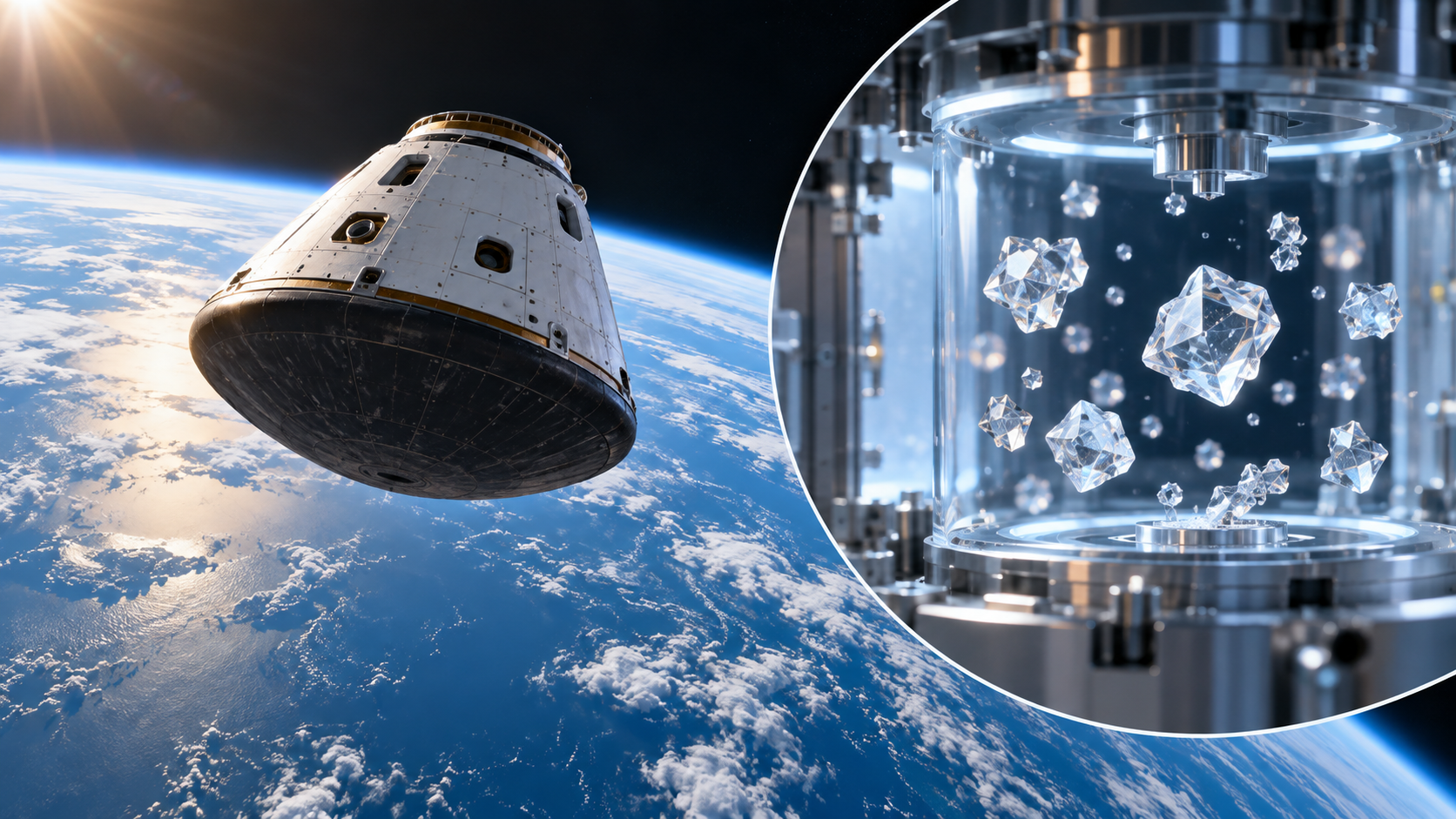
Varda Space funding has reached another major milestone with a $250 million investment announced on September 30, 2026. The financing values the company at $1.6 billion and supports its effort to expand orbital drug manufacturing. The commercial proposition is unusual but specific: use conditions in space to process pharmaceutical materials, then return those materials to Earth for examination and further development. Its significance depends on the quality of the resulting material and the reliability of the complete journey.
What the Varda Space funding needs to deliver
A larger funding round gives a company resources to develop equipment, prepare missions and support customer programmes. It does not automatically establish that a manufacturing method is ready for widespread pharmaceutical use. For Varda, the central challenge is connecting several demanding operations into one dependable service. A successful experiment must become a process that customers can specify, repeat and compare with alternatives available in terrestrial laboratories.
That distinction separates space manufacturing from a launch achievement alone. Reaching orbit is essential, but it is only one stage in the customer's project. The material must undergo the intended processing, remain suitable during the flight and survive its return in a condition that allows useful measurement. Each stage contributes to the final result. Improvements in one part of that chain can be undermined by variability elsewhere.
Why microgravity crystallization attracts interest
Varda's pharmaceutical work includes studying how different gravitational conditions influence crystallization. The company's materials describe programmes involving small molecules and biologics, alongside capabilities for experiments on Earth. Crystal properties can be relevant to pharmaceutical development because the physical form of a material affects how researchers handle and evaluate it. The scientific question is whether a particular process produces a reproducible and useful difference for a particular compound.
Microgravity crystallization should therefore be understood as an experimental manufacturing option, rather than a universal improvement that applies equally to every medicine. Researchers need suitable comparisons and clear definitions of success. A visually striking crystal, for example, would not by itself answer every question about a material's suitability. The most persuasive work connects observations to measurements that are relevant to a customer's development problem and can withstand repeated examination.
The return trip is part of the experiment
The company's published work on returning processed ritonavir highlights a practical concern: material integrity during a mission. Vibration, acceleration, radiation and temperature can affect what comes back. That makes the return capsule and its operating conditions part of the manufacturing system. Collecting a sample on Earth is not merely the closing photograph of the mission; it is a necessary step in determining whether the experiment produced usable evidence.
For a customer, careful records would make that evidence easier to interpret. If conditions change between flights, researchers need to understand which changes could explain a different outcome. Consistent handling before launch and after recovery would also matter. A well-documented process helps distinguish an effect associated with the manufacturing environment from one caused by storage, transport or measurement. This is where operational discipline becomes inseparable from scientific credibility.
Repeat missions can strengthen pharmaceutical research
Regular access would allow a development team to test a question, inspect the results and refine its next experiment. Long gaps or unpredictable schedules make that cycle more difficult to manage. A service that becomes more repeatable could help customers plan around it, although individual projects would still need a reason to choose orbital processing. Frequency has commercial value when it supports a useful research programme, not simply because more capsules are flying.
Comparisons with terrestrial methods remain especially important. An orbital process might offer a distinctive result, but customers would still examine cost, throughput and the work required to reproduce that result. They may also learn something that improves an Earth-based process. The commercial relationship does not have to depend on treating space and terrestrial laboratories as rivals. Different environments can contribute different information to the same development effort.
Manufacturing progress is separate from drug approval
Financing, launch success and an encouraging material result are distinct milestones. None should be presented as proof that a new medicine has been approved or that patients will receive a superior treatment. Pharmaceutical development involves additional work beyond producing a sample. Keeping those stages separate makes the business story more meaningful, because it allows progress to be assessed against the particular problem the company is trying to solve.
The next phase of Varda's growth will be most informative when customers can evaluate consistent results across a clearly described process. Questions about scheduling, material recovery, experimental controls and repeatability are more useful than treating the investment figure as a scientific verdict. The funding creates room to address those questions. The long-term opportunity will depend on whether orbital drug manufacturing earns a practical role within pharmaceutical research and development.
PUBLISHED BY SUYASH PACHAURI, FOUNDER & OWNER, GLOBAL BOLLYWOOD | THE HOLLYWOOD SCOPE