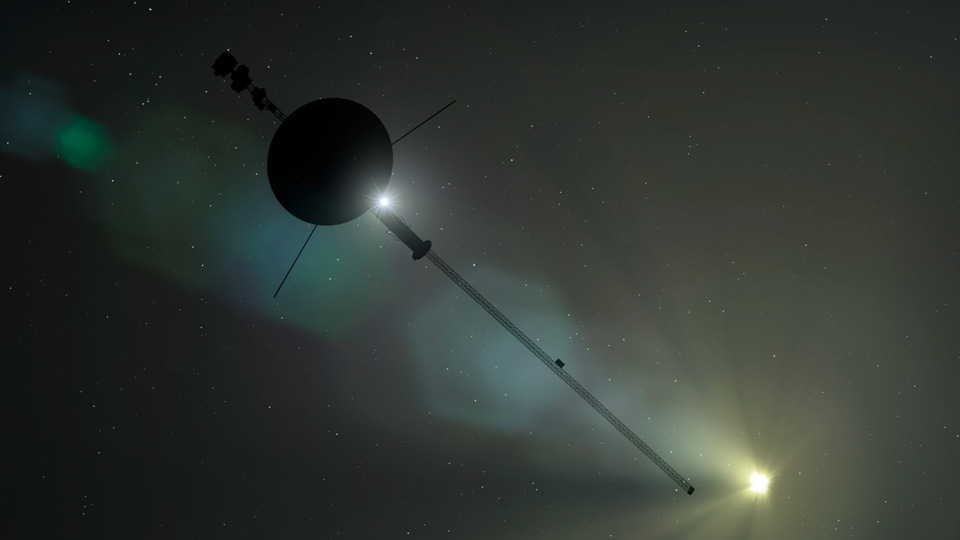
Voyager 1 has reached a distance no other human-made object has achieved, moving roughly one light-day from Earth after nearly five decades in space. The milestone means a signal traveling at the speed of light needs about 24 hours to cross the gap between Earth and the probe. The spacecraft was calculated to be about 16.094 billion miles, or 25.902 billion kilometres, away at 2:16 a.m. Pacific time on November 18, 2026. Mission teams must now wait roughly a day for its latest transmission to arrive before they can directly confirm its condition at that distance.
The achievement turns an abstract measure of deep space into a practical reality. A command sent from Earth requires about a day to reach Voyager 1, and any response needs approximately another day to return. That two-day conversation illustrates both the scale of the mission and the patience required to operate a machine launched in 1977. Voyager 1 remains the most distant known human-made object, continuing through interstellar space at almost 38,000 miles per hour while returning measurements from an environment no other active mission has sampled so far from the Sun.
What the Voyager 1 light-day milestone means
A light-day is a measure of distance rather than the age of the spacecraft or the length of its mission. It is the distance light travels in 24 hours through space. For Voyager 1, crossing that line creates an extraordinary communications delay. Controllers cannot steer it in real time, troubleshoot an unexpected reading instantly or receive immediate confirmation after transmitting a command. Every exchange unfolds across enormous intervals, so the team must plan operations with care and allow for uncertainty before deciding whether another instruction is needed.
The milestone also underscores the difference between human timescales and interstellar distances. Voyager 1 has traveled for more than 49 years and is still only one light-day away. Even so, that journey is unequalled by any other spacecraft. Its twin, Voyager 2, also operates beyond the heliosphere after entering interstellar space in 2018. Together, the two probes have become distant observatories that measure conditions beyond the protective bubble of particles and magnetic fields generated by the Sun.
A nearly 50-year mission still producing science
Voyager 1 launched in 1977 and completed close observations of Jupiter and Saturn before continuing outward. It crossed the heliopause in 2012, entering the region commonly described as interstellar space. The probe still measures magnetic fields, cosmic rays and plasma waves whenever the Deep Space Network points a suitable antenna toward it. Those measurements help researchers study how material from the Sun interacts with the space between stars and where the Sun's influence may finally give way to a more undisturbed interstellar environment.
One continuing puzzle concerns the direction of the magnetic field beyond the heliopause. Mission scientists expected a clearer rotation toward the interstellar field, yet observations have retained a direction shaped by the Sun. Voyager 1 has also detected the effects of powerful solar eruptions far from Earth, including shocks and pressure fronts generated by coronal mass ejections. Its longevity gives researchers a rare opportunity to watch those patterns evolve instead of relying on a brief passage through the boundary.
Power management is now central to the mission
Keeping the probe alive requires careful use of declining electrical power. Several instruments have been switched off over the years, including systems that either degraded or were no longer essential to the remaining science programme. Recent power-saving measures may allow communication with Earth for another three to four years. The current plan is to preserve a useful suite of instruments through the 50th anniversary of the launch in 2027, although the condition of hardware approaching half a century in service is inherently difficult to predict.
That uncertainty makes every successful transmission significant. Engineers are operating electronics designed in the 1970s at a distance where physical repair is impossible. The mission survives through disciplined power choices, careful command sequences and the global radio network that listens for its faint signal. Each decision balances immediate scientific value against the possibility of extending operations for another season. The light-day mark is therefore not merely a distance record. It is evidence that patient engineering can sustain exploration long after the original planetary encounters have ended.
Why Voyager 1 still matters
Voyager 1 offers a perspective unavailable to missions that remain close to Earth or orbit within the planetary system. Its instruments sample cosmic rays, plasma waves and magnetic conditions from beyond the heliosphere, helping scientists examine the frontier between the solar environment and the wider galaxy. The data can also refine questions for future interstellar missions, including how spacecraft should survive for decades, communicate across immense distances and operate with extremely limited power.
The one light-day milestone arrives as both a scientific achievement and a cultural marker. Humanity has sent a functioning object far enough that a radio message needs a full day to reach it. The probe continues moving into the unknown while carrying the Golden Record, a curated representation of Earth intended for a journey that will outlast its instruments. Even after communication eventually ends, Voyager 1 will remain a physical record of an era when planetary exploration expanded into the space between stars.
PUBLISHED BY SUYASH PACHAURI, FOUNDER & OWNER, GLOBAL BOLLYWOOD | THE HOLLYWOOD SCOPE.