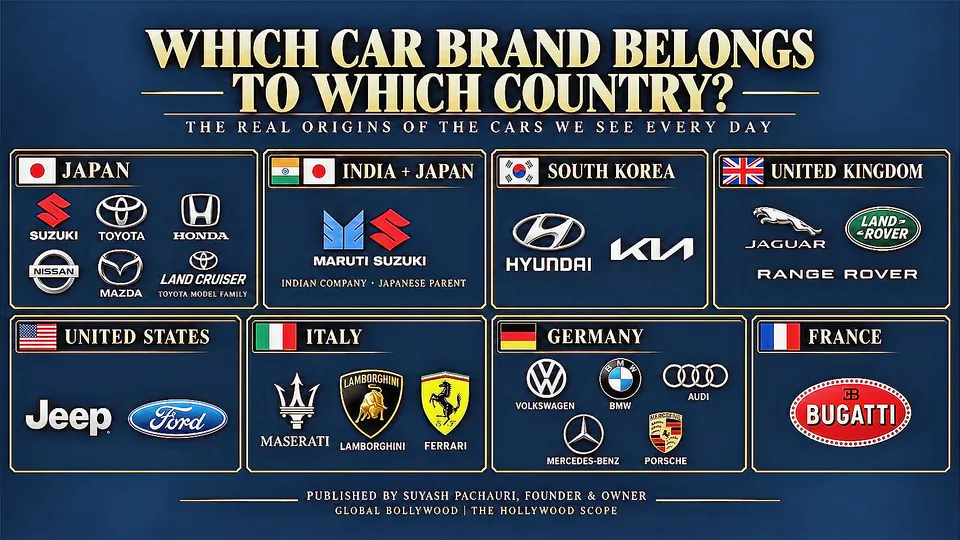
BY SUYASH PACHAURI
A car passes us on the road and, within seconds, most automobile lovers can recognise the badge.
Three pointed star? MERCEDES-BENZ. Four rings? AUDI. Prancing horse? FERRARI. Charging bull? LAMBORGHINI. Blue-and-white roundel? BMW. Three overlapping ellipses? TOYOTA.
Recognition is easy. The more interesting question is: where does that automobile brand actually belong?
Millions of people own cars produced by these companies. Millions more dream about buying one someday. Yet even regular automobile enthusiasts can become confused when asked whether a famous marque is Japanese, German, Italian, British, American, French or South Korean.
The confusion becomes even greater because today's automotive industry is international. A British automobile marque can be owned by an Indian company. An Italian supercar manufacturer can sit within a German automotive group. An American brand can belong to a multinational corporation. An Indian automobile company can have a Japanese parent. And a famous French marque can have an international ownership structure.
That means one simple rule is important before beginning this journey:
A brand's country of origin and the nationality of its present-day owner are not necessarily the same thing.
Understanding that distinction makes the global automobile map much easier to read.
So, let us travel country by country and understand some of the world's most familiar automobile names.
JAPAN: A GLOBAL POWERHOUSE OF AUTOMOBILE ENGINEERING
Japan has created some of the most trusted and internationally recognised automobile manufacturers in history. Japanese companies built enormous global reputations around engineering, efficiency, reliability and increasingly hybrid and electric technology.
SUZUKI
SUZUKI is a Japanese automobile company.
Suzuki Motor Corporation is headquartered in Hamamatsu, Shizuoka, Japan, and the corporation dates back to 1920. Its activities today go beyond automobiles and also include motorcycles and marine products.
For Indian consumers, however, the SUZUKI story becomes particularly interesting because the name is inseparably connected with MARUTI SUZUKI.
That relationship has made SUZUKI one of the most familiar Japanese automotive names in India.
MARUTI SUZUKI
Is MARUTI SUZUKI Indian or Japanese?
The most accurate answer is:
MARUTI SUZUKI is an Indian automobile company with a Japanese parent.
Maruti Suzuki India Limited operates in India and began in 1981 as Maruti Udyog Limited, originally established as a joint venture involving the Government of India and Japan's Suzuki Motor Corporation. Today, Maruti Suzuki India is a subsidiary of Suzuki Motor Corporation.
Therefore, simply calling MARUTI SUZUKI “Japanese” ignores its Indian corporate identity and history. But describing it without acknowledging its Japanese parentage would also leave out an essential part of the picture.
It is one of the best demonstrations of how modern automobile nationality can have more than one layer.
TOYOTA
TOYOTA is Japanese.
Toyota Motor Corporation was founded in 1937 and is headquartered in Toyota City, Aichi Prefecture, Japan.
Its international reach is enormous, but global manufacturing does not change its national origin. Whether a TOYOTA vehicle is built in Japan, India, North America or another market, the marque itself remains Japanese.
And within Toyota's extraordinary catalogue sits another famous name that requires clarification.
TOYOTA LAND CRUISER
Many people speak about LAND CRUISER almost as though it were an independent automobile company.
It is not.
LAND CRUISER is a model family belonging to TOYOTA.
Its lineage began in 1951 with the Toyota BJ, and Toyota later adopted the LAND CRUISER name. The model has evolved through numerous generations and series across more than seven decades.
So if somebody asks:
“Which country does LAND CRUISER belong to?”
The technically correct answer is:
LAND CRUISER → TOYOTA → JAPAN.
That distinction is important because a famous model name can occasionally become so powerful that people begin treating it as a separate manufacturer.
HONDA
HONDA is another major Japanese corporation.
Honda Motor Co., Ltd. is headquartered in Tokyo and was established in 1948. Its businesses include automobiles, motorcycles and other mobility and power products.
The company has factories and operations around the world, but its corporate origin and identity remain firmly Japanese.
From compact cars to performance engineering and motorcycles, the HONDA name has become one of Japan's most globally familiar industrial identities.
NISSAN
NISSAN is Japanese.
Nissan Motor Co., Ltd. was established in 1933 and is headquartered in Yokohama, Japan.
Over the decades, NISSAN has participated in various international partnerships and alliances. Those relationships can sometimes create confusion about nationality.
But corporate partnerships do not rewrite a brand's birthplace.
NISSAN remains a Japanese automobile manufacturer.
MAZDA
MAZDA is also Japanese.
Mazda Motor Corporation dates back to 1920 and has its principal headquarters in Hiroshima Prefecture, Japan.
While it is smaller than some automotive giants, MAZDA has retained a particularly distinctive engineering and design identity.
Its international presence does not alter its roots:
MAZDA belongs to Japan.
SOUTH KOREA: TWO NAMES THAT BECAME GLOBAL GIANTS
A few decades ago, South Korean automobiles occupied a very different position in international markets. Today, two Korean names have become impossible to ignore.
HYUNDAI
HYUNDAI belongs to South Korea.
Hyundai Motor Company is headquartered in Seoul and maintains major manufacturing and research facilities throughout South Korea as well as an enormous international network.
In markets such as India, the company has become so deeply established that some consumers may think of it almost as a domestic presence.
But the badge has a clear national origin.
HYUNDAI → SOUTH KOREA.
KIA
KIA is likewise South Korean.
Kia Corporation was established in 1944 and is headquartered in Seoul.
KIA and HYUNDAI operate with individual brand identities even though they belong within the wider South Korean Hyundai Motor Group ecosystem.
Their rapid international development is also evidence of how significantly the global automotive hierarchy can change over time.
BRITAIN: ICONIC BRANDS, GLOBAL OWNERSHIP
British automobile history has produced some of the most recognisable luxury and off-road names in the world. But this category is also one of the easiest to misunderstand because of modern ownership structures.
JAGUAR
JAGUAR is British.
Today it forms part of JLR, whose modern house-of-brands structure consists of RANGE ROVER, DEFENDER, DISCOVERY and JAGUAR. JLR describes these as distinct British brands.
However, JLR itself is part of India's Tata Motors.
Does that make JAGUAR an Indian brand?
No.
It means JAGUAR is a British automotive brand under Indian corporate ownership.
There is an important difference.
LAND ROVER
LAND ROVER is one of the great historic British automotive names, closely associated with four-wheel-drive vehicles and British engineering heritage.
But the modern JLR structure deserves explanation.
JLR now promotes RANGE ROVER, DEFENDER, DISCOVERY and JAGUAR as its four principal brands, while the LAND ROVER name continues as an important heritage mark connected with its SUV lineage.
This makes the terminology slightly different from the way generations of consumers traditionally understood Land Rover.
Its identity, however, remains British.
RANGE ROVER
RANGE ROVER is not a country, company or independent manufacturer disconnected from JLR.
Today, RANGE ROVER is positioned as one of JLR's four distinct British brands. Its ultimate corporate parent is connected to India's Tata Motors, but RANGE ROVER remains British in origin, design heritage and brand identity.
So:
RANGE ROVER → BRITISH BRAND → JLR → TATA MOTORS OWNERSHIP.
This is exactly why knowing only the parent company's nationality is not enough.
UNITED STATES: AUTOMOBILE NAMES BUILT INTO AMERICAN HISTORY
The United States was central to turning the automobile into a mass-market product, and several American automotive names became cultural institutions.
JEEP
JEEP is American.
Its heritage reaches back to the military 4x4 development of the early 1940s, and the marque itself describes its history as part of the American automotive story.
Today, however, JEEP is one of the brands within Stellantis, a multinational automotive group.
Again, modern ownership does not erase origin.
JEEP remains an American-origin automobile brand.
FORD
FORD is one of the definitive American automobile companies.
Ford Motor Company was created in 1903 by Henry Ford and his partners, beginning a corporate history that would profoundly influence mass automobile manufacturing.
Its identity remains closely associated with Michigan and the history of the American automobile industry.
Unlike some other names in this article, there is relatively little ambiguity here:
FORD → UNITED STATES OF AMERICA.
ITALY: WHEN A CAR BECOMES DESIGN, PERFORMANCE AND EMOTION
Few countries have connected automobiles with beauty, drama and motorsport as powerfully as Italy. Three names in particular represent different interpretations of Italian performance and luxury.
MASERATI
MASERATI is Italian.
Its story began in Bologna in 1914 through the Maserati brothers, while its historic modern base became Modena.
Today MASERATI is part of Stellantis, but Maserati S.p.A. remains an Italian company with its registered base in Modena.
Therefore:
MASERATI → ITALY, regardless of the international scale of its parent automotive group.
LAMBORGHINI
This is where things become even more interesting.
LAMBORGHINI is Italian.
Automobili Lamborghini S.p.A. is based in Sant'Agata Bolognese, Italy. The company itself states that it is part of the Audi Group.
And AUDI is part of Germany's Volkswagen Group, where LAMBORGHINI sits within the group's Progressive brand family alongside Audi and Bentley.
Does that make LAMBORGHINI German?
No.
LAMBORGHINI is an Italian marque under German corporate ownership.
Its design tradition, factory, heritage and national identity remain Italian.
This is perhaps one of the clearest examples of why “who owns the company?” and “which country does the brand belong to?” are two different questions.
FERRARI
If there is one automobile badge almost universally associated with Italy, it is FERRARI.
The operating company, FERRARI S.P.A., is an Italian company, while Ferrari N.V., its listed holding company, is incorporated under Dutch law.
Ferrari's principal corporate address and legendary automobile operations remain centred around Maranello and Modena in Italy.
That legal holding-company structure does not make FERRARI Dutch.
For automotive identity:
FERRARI → ITALY.
The prancing horse remains one of Italy's most internationally recognisable symbols of performance engineering.
GERMANY: PREMIUM ENGINEERING AND SOME OF THE WORLD'S STRONGEST AUTOMOTIVE GROUPS
Germany is home to an extraordinary concentration of globally recognised automobile manufacturers.
VOLKSWAGEN
VOLKSWAGEN is German.
Volkswagen Group is headquartered in Wolfsburg, Germany, and operates a vast international automotive organisation containing numerous marques from different European countries.
The fact that Volkswagen Group owns or controls brands from Italy or other European countries does not transform those marques into German brands.
The parent group may be German. The individual marque retains its own origin.
BMW
BMW belongs to Germany.
BMW Group's famous headquarters are located in Munich, and Bayerische Motoren Werke AG is registered there.
The initials themselves come from the company's Bavarian identity.
Factories and customers may span the globe, but BMW remains unmistakably German.
AUDI
AUDI is German.
AUDI AG has its headquarters in Ingolstadt, Germany, where the company also maintains major production operations.
At the corporate level, AUDI sits within Volkswagen Group and itself plays a central role in the group structure that includes LAMBORGHINI.
So the chain can be simplified like this:
LAMBORGHINI → ITALIAN BRAND
AUDI → GERMAN COMPANY
VOLKSWAGEN GROUP → GERMAN PARENT GROUP
The ownership tree crosses borders, but the brand identities remain distinct.
MERCEDES-BENZ
MERCEDES-BENZ belongs to Germany.
Mercedes-Benz Group AG is headquartered in Stuttgart, Germany, and its automotive family includes the Mercedes-Benz, Mercedes-AMG and Mercedes-Maybach names.
The three-pointed star has become one of the world's most recognisable luxury automobile symbols, but its corporate home remains German.
PORSCHE
PORSCHE is another German automotive icon.
Its identity is deeply associated with Stuttgart-Zuffenhausen, while the Porsche marque sits within Volkswagen Group's Sport Luxury structure.
So:
PORSCHE → GERMANY.
Its involvement in international corporate structures does not alter that origin.
FRANCE: THE IMPORTANT BUGATTI CORRECTION
BUGATTI
BUGATTI is French, not German.
Ettore Bugatti founded his marque in Molsheim, France, in 1909, and Bugatti continues to identify Molsheim as the historic heart of the brand.
Why, then, do people sometimes believe BUGATTI is German?
One major reason is its long corporate association with Volkswagen Group and later Porsche-linked structures.
But ownership history and brand origin are different matters.
Today BUGATTI operates within the Bugatti Rimac structure.
In September 2026, Bugatti Rimac confirmed completion of a change in ownership in which a consortium led by HOF Capital acquired Porsche's holdings in Bugatti Rimac and Rimac Group.
That corporate story may evolve again in the future. The brand's historic nationality does not.
BUGATTI → FRANCE.
This is precisely the kind of detail that makes an automobile-origin guide useful even for people who already know cars.
A CAR CAN HAVE THREE DIFFERENT IDENTITIES AT THE SAME TIME
When identifying a car marque correctly, we should ask three separate questions:
Where did the brand originate?
What national identity and heritage does it represent?
Who owns or controls it today?
Consider a few examples.
LAMBORGHINI is Italian, despite being part of a German-controlled automotive structure.
JAGUAR and RANGE ROVER are British brands even though JLR is part of Tata Motors.
JEEP is American in origin even though it belongs to Stellantis.
MARUTI SUZUKI is an Indian company whose parent is Japan's Suzuki Motor Corporation.
BUGATTI is French despite the many international corporate relationships surrounding it.
And TOYOTA LAND CRUISER is not a separate manufacturer at all; it is one of TOYOTA's celebrated model families.
That is why simply looking at the nationality of a parent corporation can produce the wrong answer.
Automobile history is more interesting than that.
FOR THE REELS GENERATION: THE 60-SECOND VERSION
COUNTRY / ORIGIN | AUTOMOBILE BRAND | IMPORTANT CLARIFICATION |
🇯🇵 JAPAN | SUZUKI | Japanese automobile manufacturer |
🇮🇳 / 🇯🇵 INDIA + JAPAN | MARUTI SUZUKI | Indian company; subsidiary of Japan's Suzuki Motor Corporation |
🇯🇵 JAPAN | TOYOTA | Japanese automobile manufacturer |
🇯🇵 JAPAN | TOYOTA LAND CRUISER | LAND CRUISER is a Toyota model family, not a separate manufacturer |
🇯🇵 JAPAN | HONDA | Japanese automobile manufacturer |
🇯🇵 JAPAN | NISSAN | Japanese automobile manufacturer |
🇯🇵 JAPAN | MAZDA | Japanese automobile manufacturer |
🇰🇷 SOUTH KOREA | HYUNDAI | South Korean automobile manufacturer |
🇰🇷 SOUTH KOREA | KIA | South Korean automobile manufacturer |
🇬🇧 UNITED KINGDOM | JAGUAR | British brand within JLR; JLR is part of Tata Motors |
🇬🇧 UNITED KINGDOM | LAND ROVER | Historic British automotive name and heritage mark within JLR |
🇬🇧 UNITED KINGDOM | RANGE ROVER | British JLR brand; parent ownership connected to Tata Motors |
🇺🇸 UNITED STATES | JEEP | American-origin brand; currently part of Stellantis |
🇺🇸 UNITED STATES | FORD | American automobile manufacturer |
🇮🇹 ITALY | MASERATI | Italian marque; part of Stellantis |
🇮🇹 ITALY | LAMBORGHINI | Italian marque; part of Audi/Volkswagen Group |
🇮🇹 ITALY | FERRARI S.P.A. | Italian automobile company |
🇩🇪 GERMANY | VOLKSWAGEN | German automobile manufacturer and group |
🇩🇪 GERMANY | BMW | German automobile manufacturer |
🇩🇪 GERMANY | AUDI | German marque within Volkswagen Group |
🇩🇪 GERMANY | MERCEDES-BENZ | German automobile marque |
🇩🇪 GERMANY | PORSCHE | German sports-car marque within Volkswagen Group |
🇫🇷 FRANCE | BUGATTI | French marque; not a German brand |
THE BADGE ON A CAR IS ONLY THE BEGINNING OF ITS STORY
The next time you see a TOYOTA, HONDA, HYUNDAI, JEEP, RANGE ROVER, FERRARI, LAMBORGHINI, BMW, MERCEDES-BENZ, PORSCHE or BUGATTI on the road, you may recognise the vehicle immediately.
But now you also know something behind the badge.
You know that a company's owner does not necessarily determine the nationality of its brand.
You know that LAMBORGHINI can be Italian while belonging to a German automotive group.
You know that JAGUAR and RANGE ROVER can remain British while their wider corporate parentage connects them to India.
You know why MARUTI SUZUKI represents a fascinating India-Japan automotive relationship.
You know that LAND CRUISER belongs to TOYOTA, rather than existing as an independent automobile manufacturer.
And perhaps most importantly, you know that BUGATTI belongs historically to France, not Germany.
Cars are machines.
But the great automobile brands are also histories, identities, engineering traditions and stories of countries that sometimes stretch across more than a century.
And sometimes, learning something new begins with nothing more complicated than looking at a familiar badge and asking:
Where did this name actually come from?
PUBLISHED
BY
SUYASH PACHAURI,
FOUNDER & OWNER,
GLOBAL BOLLYWOOD | THE HOLLYWOOD SCOPE