A case whose ending cannot return what was taken
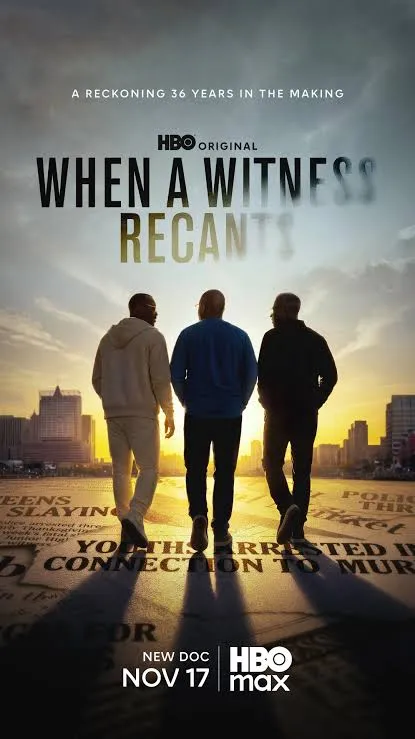
When a Witness Recants revisits the murder of 14-year-old DeWitt Duckett in Baltimore in 1983 and the convictions of Alfred Chestnut, Ransom Watkins and Andrew Stewart. The three teenagers were imprisoned for 36 years before evidence hidden from their defence helped establish that the case against them had collapsed. Director Dawn Porter treats their release as necessary justice, but never pretends it can restore the lives they were prevented from living.
The documentary runs for 112 minutes and is guided in part by writer Ta-Nehisi Coates, who grew up in Baltimore and remembered the killing as an event that altered his sense of safety. His presence supplies historical and personal context without displacing the men at the centre. The film remains focused on the people who carried the punishment, their families and the institutional choices that allowed a weak case to become a decades-long catastrophe.
The investigation is presented as a system, not an isolated mistake
The most unsettling aspect of the film is the accumulation of decisions. Witness accounts conflicted with the prosecution’s theory, exonerating information was suppressed, coerced statements were used and an alternative suspect was not seriously pursued. Rather than reducing the injustice to one villainous act, the documentary shows how incentives, career pressure and institutional loyalty can reinforce one another until doubt becomes professionally inconvenient.
That approach gives the When a Witness Recants review its central question: what happens when law-enforcement success is measured through arrests and convictions instead of accuracy? The case becomes an example of how a clearance-rate mentality can turn young suspects into answers before the facts have been established. The victim’s family is failed as completely as the wrongly convicted men because the system closes a case without delivering a trustworthy account of who committed the crime.
Dawn Porter keeps the form disciplined
Porter builds the film from archival material, documents, present-day interviews and animation. The illustrated passages acknowledge that some events cannot be reconstructed through surviving footage while avoiding the false authority of hyper-realistic recreation. Cross-cutting between past statements and later testimony allows contradictions to emerge through structure rather than constant narration.
The technique is restrained, which suits a story already heavy with anger and grief. The film does not need sensational music or elaborate reveals to create tension. A police investigator’s repeated inability to remember details during later testimony becomes more revealing each time it appears. The refusal to provide clear accountability exposes a second injury: even after exoneration, institutions and individuals can resist naming what they did.
The final meeting rejects easy closure
The most emotionally difficult material brings the three men together with a witness whose recantation helped reopen the case. Viewers may expect apology, forgiveness or a neatly staged reconciliation. The conversation does not provide that comfort. Decades of lost time cannot be balanced by a single meeting, and the men’s anger is neither edited away nor transformed into an inspirational lesson for the audience.
This refusal is the film’s strongest ethical choice. Too many true-crime stories treat release as a satisfying ending because the legal outcome has changed. When a Witness Recants insists that freedom after 36 years is also evidence of irreversible harm. A financial settlement can register official responsibility and provide material support, but it cannot create the youth, relationships and ordinary experiences that prison removed.
A focused and necessary documentary
The documentary does not claim that this case is unique. Its power comes from demonstrating how familiar patterns of coercion, suppressed evidence and institutional defensiveness can operate in a specific place. Coates helps connect the Harlem Park Three to a wider history, while Porter keeps the individual men visible inside that analysis.
When a Witness Recants is rigorous, humane and appropriately unresolved. It asks viewers to consider prevention rather than celebrating repair after the damage is complete. The film’s achievement is not that it provides emotional release, but that it makes the absence of adequate remedy impossible to ignore.
What comes next
The film is available through HBO’s services in announced territories, but streaming access can differ by country. Viewers should confirm local availability rather than assuming a US or UK listing applies globally. That practical detail does not alter the documentary’s central importance, yet accurate access information is part of responsible coverage.
Its value should continue beyond the immediate release cycle. The case offers material for discussions about disclosure duties, juvenile defendants, interrogation methods and the incentives used to evaluate police work. Educational and legal audiences may find the documentary especially useful because it links individual testimony to institutional design without turning its subjects into abstract examples.
A wrongful-conviction documentary that refuses to confuse release with restoration.
PUBLISHED BY SUYASH PACHAURI, FOUNDER & OWNER, GLOBAL BOLLYWOOD | THE HOLLYWOOD SCOPE.