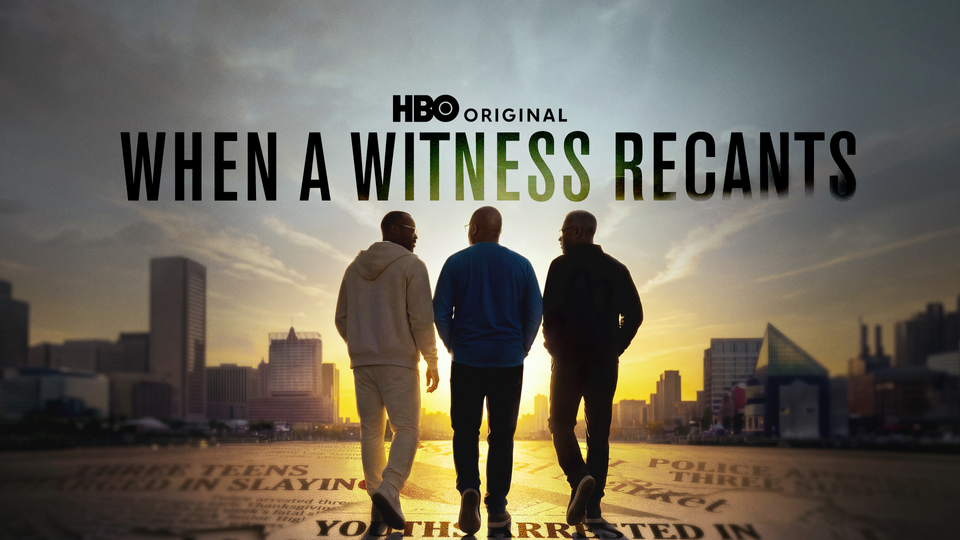
A When a Witness Recants review has to begin with the human cost behind the legal terminology. Dawn Porter's documentary examines the case of Alfred Chestnut, Ransom Watkins and Andrew Stewart, three Baltimore teenagers convicted of the 1983 murder of 14-year-old DeWitt Duckett. They lost 36 years of freedom before their convictions were overturned in 2019. The film treats their exoneration as necessary but insufficient, because release cannot return the lives, relationships and choices that imprisonment consumed.
The documentary uses narration and historical framing associated with writer Ta-Nehisi Coates, archival material, interviews and visual reconstruction to connect one case with larger failures in policing and prosecution. Its central question is not merely how a witness changed an account. It asks why officials accepted a weak theory, ignored contradictions and operated inside incentives that valued convictions and clearance rates more than accuracy.
The Harlem Park Three Case Drives the Film
Duckett was killed inside his Baltimore school during an attempt to steal his satin jacket. Chestnut, Watkins and Stewart were teenagers when they were arrested, tried and convicted. The case against them was undermined by conflicting eyewitness statements, the absence of convincing physical evidence and information pointing away from the prosecution's account.
The documentary places the three men at the center without forgetting the murdered child and his family. That balance is essential. Wrongful-conviction stories can become narratives in which the original victim disappears, but the injustice here includes both failures: authorities did not identify and convict the right person, and they denied several families a truthful account of what happened.
Coercion and Career Incentives Shape the Investigation
The film examines allegations that young witnesses were pressured and that investigators favored a theory that produced quick arrests. Children confronting police authority are especially vulnerable to suggestion, fear and the desire to end an interrogation. Once an official version hardens, later contradictions can be treated as obstacles rather than warnings.
Porter's larger argument concerns the measurements used to reward police and prosecutors. A system that celebrates closed cases and convictions can encourage certainty before the evidence supports it. Investigators may begin to interpret every fact through the chosen suspects, while evidence that points elsewhere becomes inconvenient. The documentary makes clear that misconduct does not require a single dramatic conspiracy when ordinary incentives already push people in the wrong direction.
Withheld Evidence Deepened the Injustice
The case involved material that could have supported the defense and challenged the state's narrative. When exculpatory evidence is suppressed or minimized, a trial may look procedurally complete while being deprived of the information needed for a fair result. Jurors can only evaluate what reaches the courtroom, and a verdict cannot repair a process distorted before deliberations begin.
The documentary's use of past and present statements helps viewers see how official certainty was constructed. Contradictions are not presented as abstract legal points. They become a record of decisions made by people with authority over teenagers who had little power to correct the story once it entered the courts.
Ta-Nehisi Coates Connects the Case to Baltimore History
Coates provides a bridge between the specific crime and the social environment surrounding it. His role is most useful when it expands context without turning the documentary into a story about the narrator. Baltimore's racial and economic divisions, the pressure on law enforcement and the treatment of young Black defendants are not background decoration. They shaped what officials considered plausible and whose accounts received trust.
The film also recognizes the danger of making systemic injustice feel inevitable. Patterns matter because they identify decisions that can be changed. Training, disclosure rules, interrogation practices, independent review and professional accountability all affect whether a weak case is corrected or carried through to conviction.
Freedom and Compensation Cannot Restore Lost Time
Chestnut, Watkins and Stewart were released in 2019. A later civil settlement provided financial compensation, but money cannot recreate decades of adulthood. The documentary does not treat the settlement as a happy ending that balances the equation. It is an acknowledgment from a system that has no mechanism capable of returning what it took.
That restraint gives the film its moral clarity. The men are not symbols created solely to prove an argument. They are individuals who endured imprisonment, maintained their innocence and had to build lives after release in a world transformed during their absence. Their presence prevents legal analysis from becoming emotionally remote.
When a Witness Recants is strongest as a study of institutional failure rather than a puzzle with a surprise solution. Its title identifies one turning point, but the documentary shows that the wrongful convictions required many people to overlook warning signs. The resulting film is painful not because the case is unimaginable, but because its mechanisms are recognizable and repeatable.
A hard-won exoneration exposes how easily a system can mistake a closed case for justice.
PUBLISHED BY SUYASH PACHAURI, FOUNDER & OWNER, GLOBAL BOLLYWOOD | THE HOLLYWOOD SCOPE.