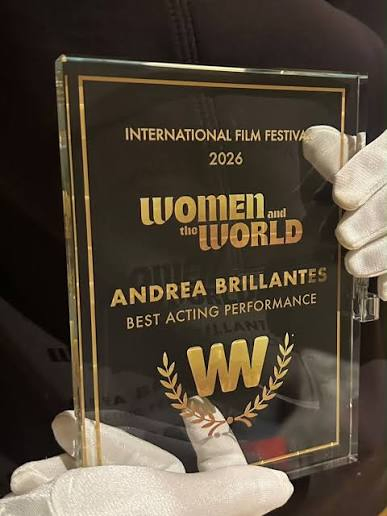
The Women and the World International Film Festival closed its 2026 London edition on 12 November with a set of awards that offers a useful record of filmmakers, performances and stories often competing for attention beyond their home territories. The third edition took place from 5 to 12 November, bringing film screenings and industry conversations into a programme concerned with women's experiences, artistic agency and the consequences of conflict. Its final results deserve attention as a completed festival record rather than as a supposedly new announcement. The closing ceremony was held at Vue West End in Leicester Square, and the prizes bring together work from the United States, the Philippines, Britain, France and Ukraine.
Rachel Feldman's LILLY earned both Best Feature Film and Best Director, placing a single production at the centre of the jury's awards. Andrea Brillantes received Best Acting Performance for Laya, while Nathalie Emmanuel was recognised with the Woman of Global Impact honour. The documentary, British short and international short categories added other distinct creative voices. These honours are not measures of box office or online popularity. They indicate which contributions a festival jury chose to distinguish within its 2026 selection, and they provide a starting point for audiences seeking films that may otherwise remain difficult to encounter.
LILLY takes the feature and directing prizes
The double recognition for LILLY gives the film two separate entries in the festival's awards history. The Best Feature Film prize recognises the production in its competitive category, while the Best Director honour names Rachel Feldman's work behind the camera. Both awards went to the United States film, and the distinction matters when maintaining an accurate record of the ceremony. A film award and an individual directing prize are related, but they are not interchangeable. Their separate recognition signals how the jury evaluated both the finished feature and the creative leadership responsible for shaping it.
LILLY centres on the legacy of Lilly Ledbetter, whose fight over unequal pay became an important part of the American debate about workplace fairness. Bringing such a subject into narrative filmmaking presents a challenge: a story rooted in legal and political history must also make personal decisions, relationships and consequences understandable on screen. The 2026 awards create an additional reason for viewers to seek out the film, but a festival result by itself cannot establish how every scene works or replace a properly viewed critical review. The durable news here is precisely what the jury awarded and to whom.
Why the double distinction matters
For directors and producers, a paired feature-and-direction result is useful filmography information for future festival submissions, programming discussions and professional biographies. It is also a reminder that a film's cultural subject and its filmmaking approach can be considered together without becoming the same question. A successful treatment of an important topic still requires coherent narrative construction and choices about performance, framing, rhythm and point of view. The two LILLY awards make those filmmaking questions worth examining, rather than settling them in advance.
Andrea Brillantes recognised for Laya
The Best Acting Performance award went to Philippine actress Andrea Brillantes for Laya. Directed by Sigrid Andrea P. Bernardo, the film had a world premiere associated with the London programme, with producer Arleen Cuevas participating in the festival. Brillantes's recognition is an individual performance award, not a declaration that Laya won the feature-film competition. Preserving that distinction is especially important for readers following an actor's career across countries, languages and different production markets. It places a clear credit beside the performer and the film rather than blending several awards into an inaccurate headline.
Laya is described as a psychological drama in which a daughter travels to an island seeking revenge against the man she believes responsible for her father's death, only to discover that the person she confronts has changed. That premise gives the central performance a demanding emotional framework, but the award cannot be used as a substitute for first-hand analysis of the finished film. Festival audiences and subsequent viewers may respond differently to its character choices. The result does, however, give the actress an international recognition that can be documented independently of short-lived social trends around the premiere.
A festival platform for films crossing borders
The visibility surrounding Laya also illustrates one practical role of a relatively focused festival. A Philippine film can enter a London screening programme and reach a gathering of filmmakers, performers, programmers and audiences who may not follow the country's regular commercial release calendar. International festival selection can expand a film's professional context even when its distribution arrangements are separate. Awards coverage is strongest when it preserves the original creative credits and selection history, rather than relying on fast-changing audience-view figures to imply a commercial result that has not been verified.
Nathalie Emmanuel receives a global-impact honour
British actress Nathalie Emmanuel was presented with the Woman of Global Impact Award, a distinction separate from the film competitions. Her international career includes Game of Thrones, the Fast and Furious franchise and The Maze Runner films. The festival linked the honour to creative achievement and influence beyond individual screen performances. Actress Sophie Winkleman, also known as Lady Sophie Windsor, supported the recognition. It is important not to mistake this award for Best Acting Performance, which was presented to Andrea Brillantes. Both names belong in the same ceremony record, but their categories recognise different contributions.
An impact award invites questions beyond the immediate success of a film. Public visibility can help performers amplify artistic work, support new talent or draw attention to subjects that receive insufficient coverage. These possibilities are worth discussing, but attributing a particular social campaign or achievement to a recipient requires independent evidence. The confirmed 2026 result is the honour itself and the festival's stated emphasis on courage, creativity and positive influence. Reporting only what is established keeps the recognition meaningful without inventing additional endorsements or claims.
Documentary and short-film winners
Dear Lara, directed by Lara St. John and representing the United States, won Best Documentary Film. That award gives a separate place to nonfiction storytelling within a programme that also included narrative features and shorts. Documentary recognition matters because its artistic methods differ from scripted drama: decisions about testimony, access, editing and the responsibility owed to real people all carry particular weight. A festival prize establishes that the documentary was selected for a category honour, but it does not by itself validate every proposition within the film. Viewers should still approach a documentary as a crafted account that merits close attention.
In the short-film categories, Swallow, directed by Kat Philippou-Curtis, received Best British Short Film, while Blueberry Summer, directed by Masha Kondakova and representing France, took Best International Short Film. These two awards should be recorded separately. One is defined by the British short category, the other by the international short category; a combined reference to short-film winners should not erase the actual labels. Shorts can provide a practical route for emerging directors to demonstrate visual precision and complete storytelling without the financial scale of a feature production. Their recognition can have lasting relevance to film catalogues and future programming.
A special mention for TRACES
The jury also gave a Special Jury Mention to TRACES, associated with filmmakers Alisa Kovalenko and Marysia Nikitiuk and identified with Ukraine and Poland. A mention is an official recognition but is distinct from an award in a named competitive category. The distinction protects the integrity of a festival's results and the credits of the filmmakers. In a programme concerned with displacement, war and the experiences of women, the inclusion of a Ukraine-Poland project is noteworthy as part of the event's artistic geography. Its exact form and subject should not be embellished without further verified film-specific detail.
Pitching recognition and development pathways
Beyond the completed films, the festival's pitching platform also recognised Pleasure, Little Treasure by Elina Alminas and The Pitch by Lada Kopytova. Development-stage projects belong in a different professional category from films that have already screened in competition. A pitch can be important because it offers visibility, contacts and feedback before financing and production are complete. It would be inaccurate to place these projects among the Best Feature Film or Best Short Film winners merely because they were recognised during the same edition. Keeping completed-film awards and pitch recognition distinct creates a cleaner historical ledger.
Festivals can serve several roles at once, but each deserves different reporting standards. Screenings allow audiences to encounter finished work; jury prizes record evaluation of selections; discussions connect people across production communities; pitching sessions may help projects find collaborators. None of those functions automatically guarantees theatrical release, streaming acquisition or financial backing. For filmmakers studying the 2026 London event, the useful information is which route each project occupied and what the event actually announced. That information remains relevant after the closing-night photographs stop circulating.
What the festival's 2026 edition represented
The week began on 5 November with a roundtable at the UK Parliament and continued through screenings, discussions and filmmaker engagement before the 12 November closing ceremony. The programme highlighted women dealing with conflict and displacement, together with stories of family, resilience, identity and creative freedom. That thematic breadth explains why the honours extend across different forms and national industries. It also points to a broader editorial challenge: festival coverage should connect individual winners to the institution's stated mission without assuming that every awarded film makes the same argument or portrays women's experiences in identical terms.
The festival additionally featured British short films in a programme presented alongside BFI NETWORK and closed with a special screening of Gentle Monster. The screening was part of the closing programme, not an additional award category. Viewers planning to research the winning titles should distinguish screenings from prize recipients and understand that festival premiere information need not imply later public availability. Distribution, territories and viewing platforms may change after a festival, so such details require checks at the moment a recommendation is made. The 2026 awards list, by contrast, can be preserved as a dated record.
A lasting reference rather than a fleeting viral moment
Social attention surrounded parts of the event, particularly the international interest in Laya, but historical reporting should not build its conclusions around an unverified or already outdated cumulative views total. Platform metrics can rise quickly, come from different accounts and represent impressions rather than unique audience members. Nor should interest in a performer be taken as proof of a film's later box-office or streaming performance. A careful account prioritises the ceremony's date, location, category labels, titles and creative credits. Those facts are substantially more useful to readers seeking a dependable archival reference.
The final picture of Women and the World International Film Festival 2026 is not dominated by a single category. LILLY led with two distinctions; Laya supplied the acting winner; Nathalie Emmanuel received the impact honour; Dear Lara, Swallow and Blueberry Summer represented other formats; TRACES received a jury mention; and two projects gained pitching-platform recognition. Together, these results demonstrate how a festival can put established public figures in the same frame as less widely known filmmakers without making their contributions interchangeable. That range is the central reason the announcement still merits a considered retrospective article.
For film professionals, the record may inform future viewing lists, collaboration research and the tracking of women-led projects across different markets. For general audiences, it offers clear entry points into films that they may have missed during the original London screenings. Any subsequent release, award or commercial milestone should be reported separately with its own verified date rather than folded retroactively into the 12 November results. The awards ceremony is over, but its confirmed information remains useful precisely because the article identifies what happened then, avoids inventing what happened next, and allows the films themselves to be discovered on their own merits.
PUBLISHED BY SUYASH PACHAURI, FOUNDER & OWNER, GLOBAL BOLLYWOOD | THE HOLLYWOOD SCOPE.