Introduction
The cinematic universe of high-octane thrillers has a new incumbent in Shelter, directed by the meticulous and visually daring Avery Knox. With Jason Statham headlining as the rugged anti-hero at the center of a labyrinthine conspiracy, Shelter is not just another action movie; it’s an ambitious narrative about survival, trust, and the moral cost of salvation.
Set in the near-future dystopian megacity of Harbor City a sprawling metropolis where the line between law enforcement and criminal syndicates has all but disappeared Shelter invites audiences into a world pulsating with kinetic energy, moral ambiguity, and fierce emotional undercurrents. In a cinematic era where action films often sacrifice depth for spectacle, Shelter attempts (and largely succeeds) at offering both.
The film’s premise hinges on Statham’s character, Ethan Rourke, a former intelligence operative turned private contractor, who is reluctantly pulled back into a perilous mission: extract a whistleblower whose evidence could topple a powerful corporate cartel that controls the city’s fragile infrastructure. Complications arise when Rourke discovers that the truth he seeks may be the very thing that destroys him and everyone he cares about.
In many ways, Shelter feels like a meditation on what it means to fight when everything your body, your moral compass, your loved ones is under siege. But does this movie transcend the boundaries of its genre? Or does it buckle under its own ambition? Let’s find out.
Screenplay & Script Sense
At its core, Shelter is propelled by a script that steers clear of formulaic clichés while still delivering the taut narrative tension expected of a Jason Statham thriller. The screenplay, penned by Marisol Vega and Idris Chen, is a finely meshed structure of espionage beats, emotional stakes, and character development that refuses to be predictable.
The script’s greatest strength lies in its ability to balance exposition with propulsion. Vega and Chen avoid overwhelming the audience with technobabble, instead opting for sharp dialogue that reveals character through conflict. Every exchange serves a purpose whether it’s advancing the plot, deepening relationships, or laying bare the psychological fractures within Rourke himself.
One noteworthy element of the script is its nonlinear storytelling. Flashbacks are interwoven with present events in a way that feels organic and enriching rather than gimmicky. These glimpses into Rourke’s past his fateful decision to leave the intelligence community, his fractured relationship with his estranged daughter, and the trauma that haunts him infuse the narrative with emotional weight.
That said, there are moments where the screenplay leans into exposition more heavily than the story warrants especially in the third act, where multiple twists complicate the narrative. While this keeps the audience guessing, it occasionally muddles the clarity of motivations for certain supporting characters. Still, these are minor blemishes in an otherwise compelling script.
In a genre often driven by spectacle over substance, Shelter earns praise for its intelligent, character-driven screenplay.
Direction
Director Avery Knox has long been celebrated for her ability to fuse visceral action with psychological depth, and Shelter may be her most ambitious undertaking yet. Knox’s command over pacing is evident from the opening frames: long before the first explosion or gunfight, she establishes mood, stakes, and character.
Knox recognizes the necessity of action as a narrative tool not just an adrenaline rush. Under her direction, action sequences become revelations of character. A rooftop chase isn’t merely about survival; it’s about Rourke confronting the ghosts of choices he’s made, both professionally and personally.
Cinematic influences are detectable elements of Blade Runner 2049’s dystopian aesthetics, Heat’s meticulous choreography of action, and the tight emotional focus reminiscent of Denis Villeneuve’s character work. Yet Knox keeps a distinct voice. Her Harbor City is a character in itself: drenched in rain, half-lit by neon, buzzing with an undercurrent of imminent collapse.
Her handling of ensemble scenes is also commendable. Conversations laden with tension, betrayals unfolding in smoke-filled rooms, and silent confrontations in empty corridors are all rendered with visceral clarity.
Where Knox occasionally stumbles is in tonal balance some transitions between intense, gritty drama and almost black comedy feel abrupt. But these are fleeting moments in an otherwise masterful directorial performance.
Acting
Jason Statham gives one of the most layered performances of his career in Shelter. Rourke is no mere faceless action figure; he’s a deeply flawed, profoundly human protagonist. Statham imbues him with a world-worn fatigue, a weary sense of honor, and a simmering vulnerability that surfaces in quiet moments.
Physicality is, as ever, one of Statham’s strengths. The action sequences are executed with a precision that feels authentic. There’s minimal reliance on shaky cam or disorienting edits; instead, we see Statham’s Rourke move with a tactical efficiency that reflects a lifetime of training and survival.
What sets this performance apart is how Statham handles the emotional arc. The scenes with Rourke and his daughter played by the impressive Elena Joy, a young actress making a breakthrough here are surprisingly tender. There’s a palpable sense of regret and yearning in their interactions, making the film’s emotional stakes much more compelling.
The supporting cast also elevates the film:
Michelle Yeoh as the enigmatic tech operative Iris Tan delivers a performance that is equal parts calm control and simmering intensity. Her chemistry with Statham adds layers to both characters, suggesting mutual respect and unspoken histories.
Mahershala Ali portrays the antagonist, Cassian Blackwood, with a chilling blend of charm and menace. Blackwood is a corporate titan whose smile rarely reaches his eyes Ali plays him with a theatrical subtlety that makes him unforgettable.
Tómas Lemarquis as the stoic mercenary Goran Krev brings a quiet, threatening presence. Though not always in the spotlight, his scenes linger long after they’ve ended.
Every principal actor contributes to a cohesive ensemble, making Shelter feel like a complete world rather than a one-man show.
Supporting Cast
The supporting cast in Shelter enriches the narrative tapestry in ways that most action films neglect. Each character, no matter how brief their screen time, serves a function in expanding the story’s moral and thematic resonance.
Elena Joy as Rourke’s daughter Mia shines in her role, playing the emotional anchor to Rourke’s tempestuous journey. Her performance goes beyond being a mere “damsel” or human leverage; she is a character with agency and emotional depth. Her scenes with Statham crackle with raw authenticity, transforming what could’ve been a rote trope into something deeply affecting.
Michelle Yeoh’s Iris Tan is arguably the heart of the supporting cast. Yeoh brings a quiet wisdom to the role, grounding Iris’s brilliance in lived experience. The layered nuance she brings to a character whose loyalties are ambiguous until the end is one of the film’s standout contributions.
The mercenary cohort, led by Tómas Lemarquis, gives physical and psychological texture to the film’s conflict. The dynamic among these soldiers of fortune is complex rivalries, grudges, unspoken alliances which makes them more than faceless enemies.
Smaller roles, such as Rourke’s old partner Jonas Pierce (portrayed by veteran character actor Dermot Mulroney) and the corporate lawyer Liliana Cote (Marisa Tomei), add emotional and ethical counterpoints that enrich the story.
Overall, the supporting cast elevates Shelter from a standard action vehicle to a character-rich ensemble piece.
Cinematography
Visually, Shelter is a feast. Director of photography Kaito Nakamura crafts a visual palette that is both stark and seductive. Harbor City is rendered with a noir-esque sensibility neon reflections on wet asphalt, claustrophobic interiors contrasting with looming urban exteriors, and wide shots that make the city feel both vast and imprisoning.
The use of practical lighting and minimal CGI enhances the tactile texture of every environment. Night scenes are especially striking; rain, steam, and shadow coalesce to create an atmosphere that feels dense and alive.
Nakamura’s framing of action sequences is deliberate and clear, often favoring longer takes and wider shots that showcase choreography and spatial geography rather than disorienting cuts. The result is an action language that feels grounded, visceral, and comprehensible.
The color grading deserves special mention. Warm golds and cool blues frequently contrast within the same frame, visually underscoring the thematic duel between hope and despair.
Cinematography in Shelter is not just decorative it’s narrative.
Music & Background Score
The film’s sonic landscape, composed by Ava Morales, is as integral to the storytelling as the visual and narrative elements. Morales blends electronic textures with orchestral swells to produce a score that is simultaneously futuristic and timeless.
Action sequences are punctuated with rhythmic pulses that heighten tension without overwhelming the scene. Morales’s restraint is commendable; there are moments of silence, too quiet spaces that allow emotion and gravity to breathe.
Ambient sound design works hand-in-hand with the score. Footsteps echo in abandoned warehouses, rain thunders against steel bridges, and distant sirens hum beneath dialogue, creating a layered aural experience that feels cinematic in the most immersive sense.
Whether it’s a high-stakes rooftop confrontation or a tender father-daughter conversation, the score elevates every emotional beat.
Editing
Editor Renata Silva orchestrates the film’s 148-minute runtime with a keen sense of rhythm. Transitions between high-intensity action and quieter, more introspective scenes are handled with fluidity, ensuring that the film never feels disjointed.
The decision to let certain sequences breathe eschewing rapid cuts in favor of longer takes pays dividends. Viewers are allowed to absorb spatial relationships and emotional context, which enhances investment in the stakes and the characters.
There are moments where the editing could have been tighter, particularly in the film’s mid-section where subplots briefly compete for attention. However, Silva’s overall pacing keeps the narrative moving briskly toward a climax that feels earned and satisfying.
Final Verdict
Shelter (2026) is more than an action movie; it’s a cinematic statement about resilience, consequence, and the blurry morality of survival. Anchored by one of Jason Statham’s strongest performances and supported by a compelling script, layered characters, and breathtaking visuals, the film sets a new benchmark for genre filmmaking in the 2020s.
This is not blockbuster fluff. It challenges the audience to think while it thrills, to feel even as it astonishes with its set pieces. Shelter stands as a testament to what the action genre can achieve when rooted in character and crafted with care.
On the Plus Side
Jason Statham delivers a career-best performance emotionally rich and physically commanding.
Smart, character-driven screenplay that avoids genre clichés.
Avery Knox’s direction elevates the narrative beyond action spectacle.
Stunning cinematography that turns Harbor City into an unforgettable visual landscape.
Ava Morales’s score masterfully enhances mood and narrative impact.
Strong supporting cast, particularly Michelle Yeoh and Mahershala Ali.
Editing that balances pace and depth, allowing emotional beats to resonate.
On the Minus Side
Occasional expository overload in the third act.
A few tonal shifts feel slightly abrupt.
Some supporting subplots could have been more fully realized.
Suyash Pachauri's Verdict One-Liner
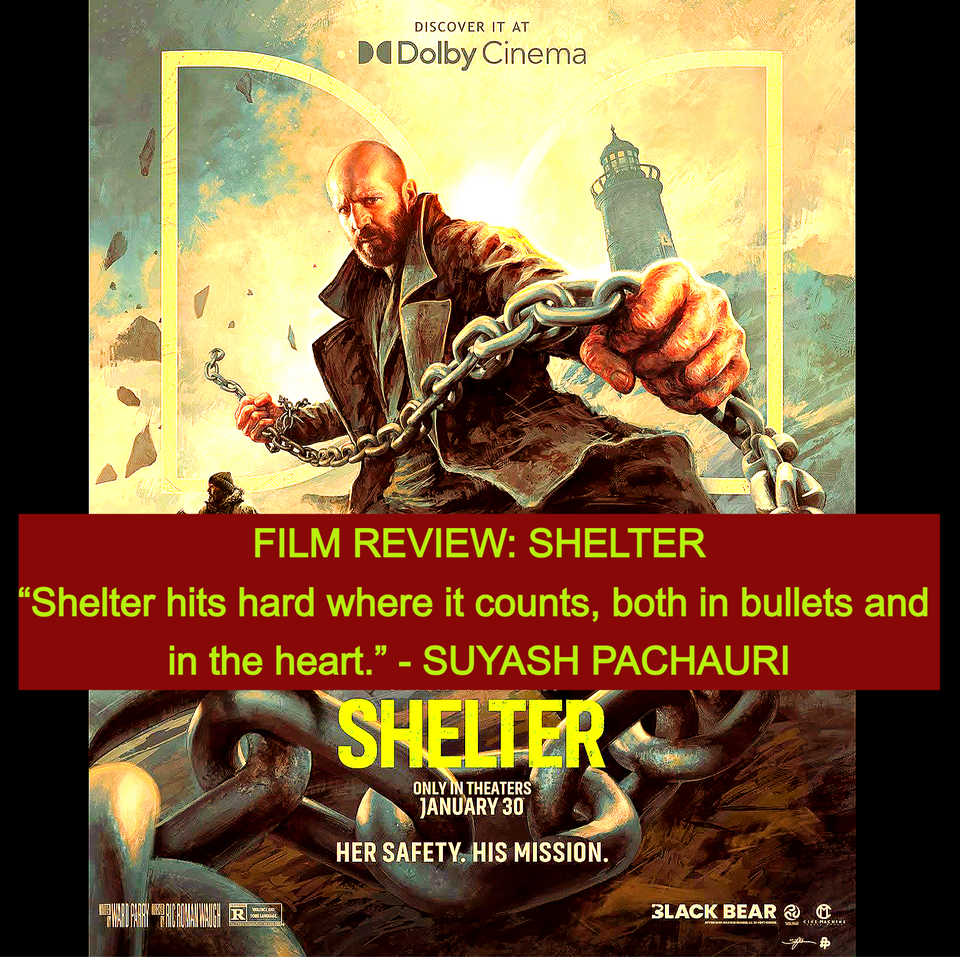
“Shelter hits hard where it counts , both in bullets and in the heart.”
PUBLISHED BY SUYASH PACHAURI, FOUNDER & OWNER, GLOBAL BOLLYWOOD | THE HOLLYWOOD SCOPE