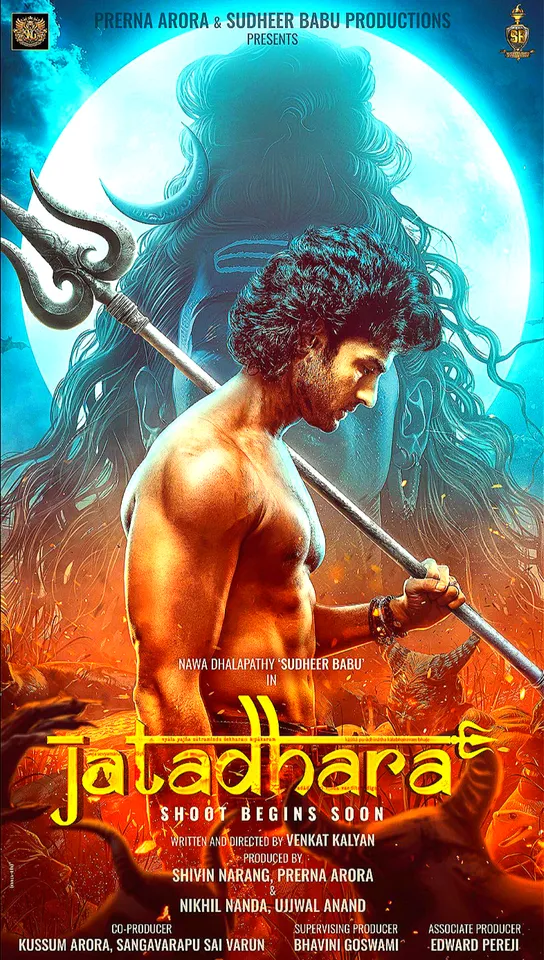
Introduction
Jatadhaara arrives as an ambitious cinematic attempt to merge mythology, mysticism, and contemporary narrative sensibilities into a single, cohesive vision. Rooted deeply in Indic spiritual symbolism, the film dares to explore themes of faith, destiny, power, and cosmic balance subjects that demand not only creative courage but also narrative discipline. In an era where mythological references are often reduced to spectacle or surface-level symbolism, Jatadhaara strives to go deeper, seeking meaning rather than mere visual awe.
The film positions itself at the intersection of belief and skepticism, ancient wisdom and modern consciousness. It is neither a straightforward mythological retelling nor a conventional fantasy drama. Instead, Jatadhaara unfolds as a philosophical journey, one that asks questions about spiritual inheritance, moral responsibility, and the cyclical nature of existence.
From its opening moments, the film establishes a serious, contemplative tone. This is cinema that expects engagement, not passive consumption. While this approach may not cater to all audience segments, it clearly defines the film’s identity. Jatadhaara is not afraid to slow down, to invoke silence, or to let symbolism speak louder than dialogue.
Screenplay & Script Sense
The screenplay of Jatadhaara is undoubtedly its most ambitious element. Structured around layered timelines, metaphors, and spiritual allegories, the script attempts to weave the material and the metaphysical into a unified narrative fabric. Rather than spoon-feeding mythology, the screenplay invites the audience to interpret, reflect, and connect dots independently.
The writing draws heavily from spiritual philosophy, using symbolism as a narrative device rather than relying on exposition. Concepts of karma, cosmic duty, and inner awakening are embedded within character journeys, making the script intellectually stimulating but also demanding.
Dialogues are often poetic, sometimes cryptic, and intentionally restrained. While this adds depth and authenticity to the film’s spiritual tone, it also creates moments of narrative opacity. Certain plot transitions feel abstract, requiring patience and attentiveness from the viewer.
Where the screenplay excels is in its thematic consistency. Every narrative thread ultimately feeds into the film’s central idea of balance between destruction and creation, belief and doubt, and self and universe. However, the script occasionally overextends its philosophical ambitions, resulting in narrative density that may overwhelm viewers unfamiliar with such storytelling modes.
A slightly more streamlined approach could have improved accessibility without diluting thematic richness.
Direction
The direction of Jatadhaara reflects a bold and uncompromising vision. The director approaches the material with reverence and seriousness, avoiding the temptation to commercialize or oversimplify spiritual themes. This commitment is evident in the film’s pacing, visual language, and tonal discipline.
One of the director’s strengths lies in atmosphere-building. Scenes are allowed to unfold organically, often relying on visual symbolism and ambient sound rather than dialogue. The director doesn't overexplain or sensationalize because he believes that the audience is intelligent.
The film’s spiritual moments are treated with dignity, avoiding kitsch or melodrama. Rituals, silences, and meditative sequences are integrated seamlessly into the narrative flow, enhancing authenticity.
That said, the direction occasionally becomes indulgent. Certain sequences linger longer than necessary, potentially testing audience patience. While this may be intentional to mirror spiritual stillness, it slightly disrupts narrative momentum.
Nevertheless, the director’s clarity of intent and thematic conviction elevate Jatadhaara as a sincere and courageous cinematic effort.
Acting
The performances in Jatadhaara are grounded, restrained, and emotionally sincere. The lead actor shoulders a complex role that demands both internalized emotion and spiritual gravitas. Rather than resorting to exaggerated expressions, the performance is driven by subtle shifts in demeanor, controlled body language, and reflective silences.
The actor convincingly portrays a character torn between rational thought and spiritual awakening. This internal conflict forms the emotional backbone of the film, and the performance ensures that the character remains relatable despite the film’s abstract themes.
The female lead delivers a performance marked by calm strength and emotional intelligence. Her character functions as both emotional anchor and spiritual mirror, and the actor brings quiet authority to the role. She avoids archetypal portrayals, offering nuance and emotional depth.
The chemistry between the leads is understated, rooted more in shared purpose and spiritual alignment than romantic expression. This choice aligns well with the film’s thematic framework.
Supporting Cast
The supporting cast in Jatadhaara plays a crucial role in expanding the film’s spiritual universe. From sages and seekers to skeptics and observers, each character contributes symbolically to the narrative.
While many supporting roles are limited in screen time, they are portrayed with conviction and sincerity. These characters often serve as philosophical voices rather than narrative drivers, reinforcing the film’s allegorical structure.
Some supporting performances stand out due to their authenticity and restraint, though deeper character exploration could have enhanced emotional resonance. Still, the supporting cast effectively supports the film’s thematic weight without overshadowing the central journey.
Cinematography
Cinematography is one of Jatadhaara’s most powerful assets. The visual language is rich, immersive, and deeply symbolic. Natural landscapes, sacred spaces, and elemental imagery (water, fire, earth, and sky) are used not merely as backdrops but as narrative elements.
The camera often moves slowly, contemplatively, encouraging viewers to absorb the visual symbolism. Wide frames establish cosmic scale, while close-ups capture inner transformation. Lighting plays a crucial role, with shadows and natural light reflecting moral and spiritual states.
The cinematography successfully bridges the earthly and the ethereal, making the film visually meditative rather than conventionally spectacular.
Music & Background Score
The music of Jatadhaara is minimalistic and spiritually resonant. Instead of traditional song structures, the score relies on ambient textures, chants, and instrumental motifs that echo the film’s philosophical themes.
The background score enhances mood without overpowering scenes. Silence is used as a deliberate musical choice, allowing spiritual moments to breathe.
This restrained musical approach may not appeal to audiences expecting melodic songs, but it aligns perfectly with the film’s contemplative tone and narrative intent.
Editing
The editing of Jatadhaara reflects the film’s meditative rhythm. Scenes transition smoothly, maintaining tonal consistency and narrative clarity despite the film’s layered structure.
However, the pacing is deliberately slow, and certain sequences could have benefited from tighter editing. While the extended runtime allows thematic immersion, it may challenge viewers accustomed to faster storytelling.
That said, the editing respects the film’s spiritual tempo and avoids abrupt or jarring transitions.
Final Verdict
Jatadhaara is not a film for casual viewing. It is a contemplative, spiritually driven cinematic experience that demands patience, openness, and intellectual engagement. Its ambition is commendable, even when execution occasionally falters.
The film succeeds in creating a world that feels spiritually authentic and philosophically rich. While its abstract storytelling and slow pace may limit mass appeal, Jatadhaara stands out as a bold and sincere attempt to explore deeper existential questions through cinema.
On the Plus Side
Ambitious and spiritually rich narrative
Strong atmospheric direction
Visually immersive cinematography
Restrained and sincere performances
Thought-provoking themes
On the Minus Side
Slow pacing may test patience
Dense symbolism reduces accessibility
Limited emotional depth for some supporting characters
Jatadhaara is a meditative cinematic journey, one that values introspection over entertainment and meaning over momentum. It may not resonate with everyone, but for those willing to engage, it offers a rare and rewarding spiritual experience.
PUBLISHED BY SUYASH PACHAURI, FOUNDER & OWNER, GLOBAL BOLLYWOOD | THE HOLLYWOOD SCOPE