FILM REVIEW
Introduction
Few Indian film franchises have managed to sustain suspense and emotional investment as consistently as Drishyam. What began as a grounded family drama wrapped inside a thriller has evolved into one of Indian cinema's most recognisable mystery sagas.
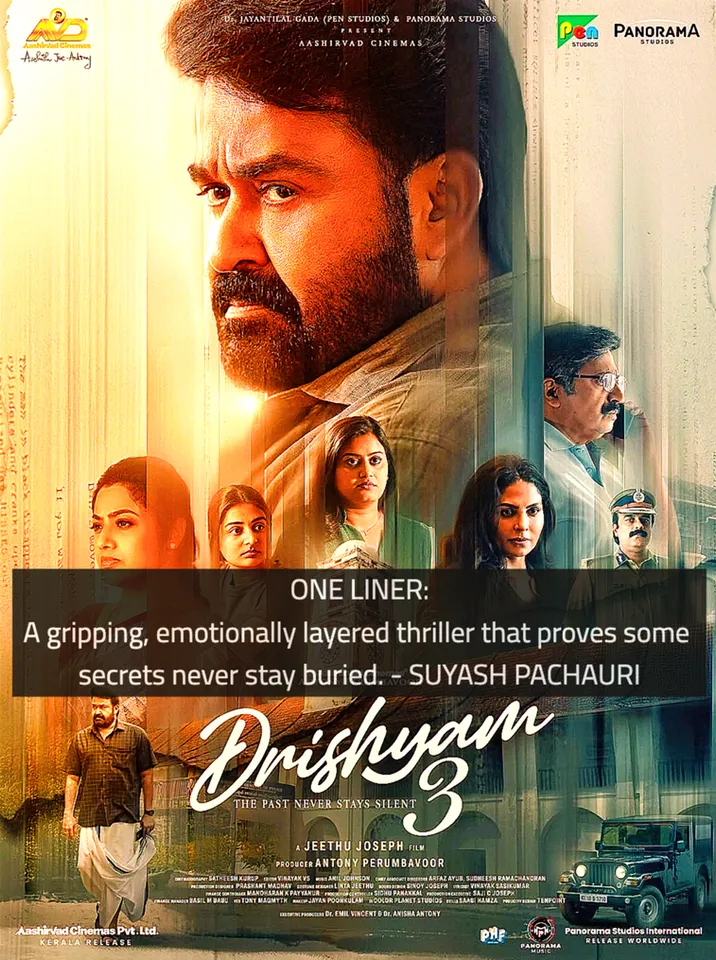
Drishyam 3 returns to the world of Georgekutty, a man whose intelligence, determination, and love for his family have repeatedly helped him outwit impossible situations. Rather than simply trying to recreate the magic of its predecessors, the third chapter shifts its focus toward the emotional consequences of past decisions and the burden of living with secrets that refuse to disappear.
While the film retains the franchise's trademark slow-burn storytelling and carefully planted narrative clues, it also spends considerable time exploring guilt, fear, and the psychological scars carried by every member of Georgekutty's family. The result is a film that remains engaging throughout, even if it occasionally revisits familiar territory.
Screenplay & Script Sense
The screenplay is undoubtedly the strongest pillar of Drishyam 3. Instead of depending solely on shocking twists, the writing patiently builds tension through everyday conversations, subtle character interactions, and carefully layered situations. The story understands that audiences already know Georgekutty's capabilities, so rather than trying to surprise viewers every few minutes, it focuses on creating uncertainty around how events will eventually unfold.
The first half progresses at a measured pace. It revisits the emotional damage left behind by the earlier incidents while gradually introducing new threats that challenge Georgekutty's carefully constructed world.
Although some viewers may find this portion slower than expected, it serves an important purpose by strengthening the emotional stakes before the narrative accelerates.
The second half is considerably more gripping.
Once the central conflict gains momentum, the screenplay effectively combines suspense, emotion, and moral ambiguity.
The film constantly forces viewers to question the difference between justice and protection, legality and morality, making it more than just a conventional thriller.
Certain dramatic stretches could have been more concise, and a few emotional beats rely heavily on melodrama. Nevertheless, the screenplay succeeds in maintaining audience curiosity while delivering an emotionally satisfying progression.
Direction
Jeethu Joseph once again demonstrates why he understands these characters better than anyone else. His direction avoids unnecessary spectacle and instead emphasizes realism, silence, and emotional tension.
Rather than overwhelming viewers with action sequences or exaggerated confrontations, he relies on performances and carefully constructed situations to generate suspense.
His greatest strength remains his ability to transform ordinary locations and simple conversations into scenes filled with anxiety.
Everyday family interactions suddenly feel significant because viewers know that danger could emerge at any moment.
However, the film occasionally lingers too long on emotional moments that have already conveyed their purpose.
A tighter narrative rhythm in the opening portions would have made the overall experience even more compelling.
Still, Jeethu Joseph successfully preserves the identity of the franchise without compromising its emotional core.
Acting
Mohanlal once again delivers a performance built on restraint rather than dramatic flourishes. His portrayal of Georgekutty is remarkably controlled, conveying exhaustion, intelligence, vulnerability, and determination with minimal dialogue. Instead of portraying a larger-than-life hero, he presents a deeply human father trying to protect everything he values. His expressions, body language, and understated emotional transitions remain among the film's biggest strengths.
Meena provides warmth and emotional stability as Rani. Her performance effectively communicates the constant fear and uncertainty of a mother attempting to keep her family together despite overwhelming circumstances. While the screenplay doesn't always give her substantial dramatic moments, she remains convincing throughout.
Ansiba Hassan delivers one of the film's most emotionally affecting performances. As Anju, she convincingly portrays someone who continues to struggle with unresolved trauma. Her quiet suffering, hesitation, and emotional vulnerability add considerable weight to several scenes.
Esther Anil brings fresh energy to her role as Anu. She displays greater maturity compared to previous installments and contributes effectively whenever the story focuses on the younger generation.
Asha Sharath performs with controlled intensity as Geetha Prabhakar. She effectively portrays a grieving mother whose pain has never diminished. Her confrontational scenes carry emotional conviction without becoming overly theatrical.
Siddique once again leaves a strong impression through his dignified screen presence. His restrained performance reflects a father torn between grief and helplessness.
Murali Gopy contributes effectively whenever the investigation gains momentum, adding seriousness and credibility to the narrative.
Kalabhavan Shajohn, Ganesh Kumar, and the supporting investigative team continue to provide familiarity while strengthening the procedural elements of the story.
Overall, the ensemble functions cohesively, allowing the emotional conflicts to feel believable.
Supporting Cast
One of the franchise's biggest strengths has always been its supporting characters. Instead of existing merely as background figures, they contribute meaningfully to the progression of events.
Every supporting character carries emotional baggage connected to previous incidents, making even brief appearances feel relevant.
Whether portraying police officers, friends, neighbours, or extended family members, the cast helps maintain the realistic atmosphere that distinguishes Drishyam from conventional thrillers.
Although a few characters could have benefited from greater development, none feel completely unnecessary.
Cinematography
The cinematography remains understated yet effective. Rather than relying on flashy visuals, the camera quietly observes the characters, allowing viewers to remain emotionally connected to their experiences.
The natural landscapes, interiors, and rural surroundings continue to reinforce the grounded realism of the franchise. Close-up shots are used thoughtfully during emotionally charged scenes, while wider compositions effectively establish the calm environment surrounding the growing psychological tension.
Lighting and framing complement the story without drawing unnecessary attention to themselves.
Music & Background Score
The background score successfully enhances suspense without becoming intrusive. It quietly builds tension during investigative sequences while allowing emotional scenes to breathe naturally.
Unlike many thrillers that depend heavily on loud musical cues, Drishyam 3 exercises restraint. Silence often becomes just as powerful as music, increasing the psychological impact of several important moments.
The soundtrack itself remains functional rather than memorable, but the background score effectively supports the film's overall atmosphere.
Editing
Considering the film's lengthy runtime, the editing generally maintains narrative clarity. The transitions between emotional drama and investigative suspense are smooth, allowing viewers to follow multiple story threads comfortably.
However, a slightly tighter first half would have improved pacing. Some conversations and emotional repetitions could have been shortened without affecting the central narrative.
Despite these minor issues, the editing successfully preserves continuity while allowing important emotional moments sufficient breathing space.
Verdict
Drishyam 3 may not completely recreate the surprise factor that made the original film a modern classic, but it succeeds in offering a thoughtful continuation of Georgekutty's journey. Instead of relying purely on twists, the film explores the emotional consequences of living with secrets and the sacrifices people make for those they love.
Its strongest assets remain its intelligent screenplay, emotionally grounded performances, and Jeethu Joseph's ability to create suspense from ordinary situations. While the pacing occasionally slows and certain dramatic stretches feel familiar, the film ultimately rewards patient viewers with an engaging and emotionally satisfying experience.
Rather than functioning as just another thriller, Drishyam 3 becomes a story about family, guilt, survival, and the complicated relationship between truth and justice.
On the Plus Side
Strong screenplay with layered storytelling.
Mohanlal delivers another deeply convincing performance.
Emotional depth complements the suspense effectively.
Excellent supporting performances.
Realistic direction with impressive narrative control.
Effective background score and grounded cinematography.
On the Minus Side
Slow paced opening stretches.
Some emotional scenes feel repetitive.
Certain supporting characters deserved greater exploration.
Familiar narrative structure reduces the surprise factor.
One Liner
More than a thriller, Drishyam 3 is an emotional examination of how far a father will go to protect his family and what those choices ultimately cost.
FILM REVIEW
Disclaimer:
This review is an independent editorial opinion intended for informational purposes. It is based on publicly available information and general critical analysis and is not sponsored, commissioned, or influenced by the filmmakers, producers, distributors, or anyone associated with the film.
PUBLISHED BY SUYASH PACHAURI, FOUNDER & OWNER, GLOBAL BOLLYWOOD | THE HOLLYWOOD SCOPE