Direction
Direction is where cinema gains identity. A director's responsibility is not only to tell a story but also maintain consistency in tone and energy.
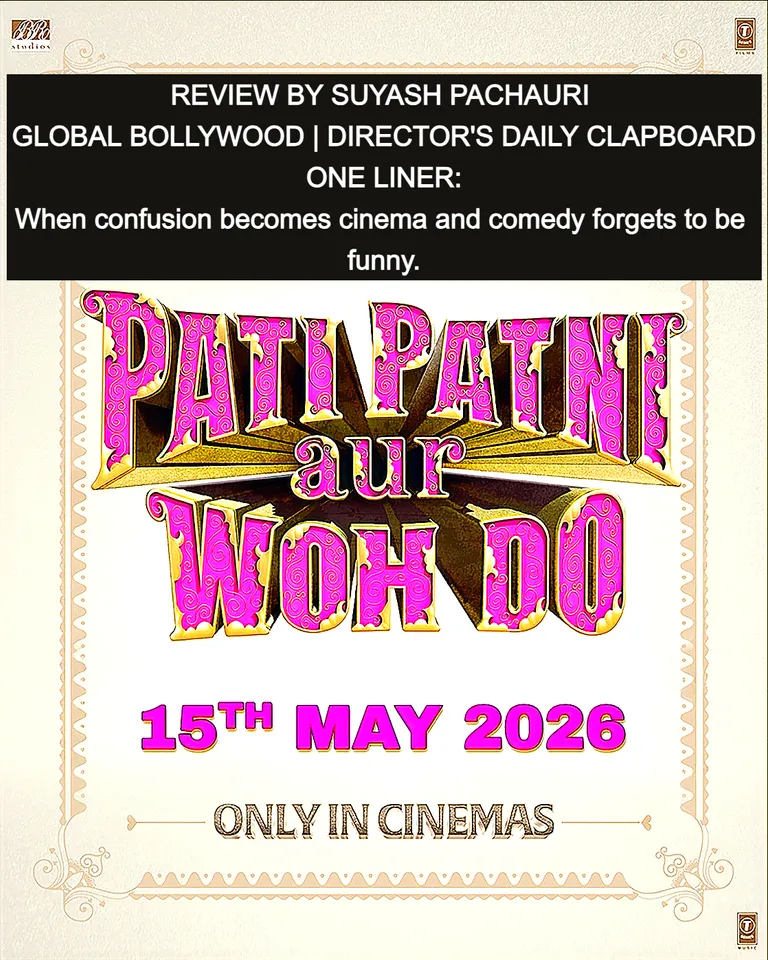
Unfortunately, Pati Patni Aur Woh Do, directed by Mudassar Aziz, suffers from a severe identity crisis.
The direction lacks command over mood and pacing. Scenes move with uneven rhythm. Moments that should feel funny are overstretched while emotionally important scenes are rushed.
Comedy works best when chaos feels controlled. Here chaos becomes careless.
Several situations look like improvisation gone wrong. Instead of creating believable comic tension, scenes become awkward and unnecessarily prolonged.
The film repeatedly shifts between exaggerated comedy and forced sentimentality without preparing audiences emotionally.
A stronger director could perhaps have transformed this material into a decent entertainer.
But here the storytelling never feels confident. There is no visual personality. No storytelling style. No creative risk. No signature. The film simply unfolds scene by scene without leaving any cinematic imprint. And that's disappointing because even average stories can become enjoyable with confident execution.
Acting
The cast clearly puts in effort, and that effort is visible throughout the film. Ayushmann Khurrana, playing the husband, brings energy to the role but struggles with the emotional and comic weight it demands. His expressions begin to feel repetitive, and instead of reacting naturally, he often drifts into overacting.
Wamiqa Gabbi, portraying the wife, delivers a sincere performance, but the character itself is underwritten and lacks depth, making it difficult for her to rise above the script’s limitations. The third angle the “woh” factor, played through characters involving Sara Ali Khan and Rakul Preet Singh, around whom much of the chaos revolves also feels disappointingly one-dimensional. Rather than becoming memorable or injecting unpredictability into the story, the character remains confined to familiar clichés.
Several emotional scenes further reveal performance weaknesses, as the actors seem more focused on delivering lines than genuinely feeling them. Comic timing, too, feels uneven: some reactions arrive too late, some are exaggerated, and others simply fail to land. No performance is outright bad, but none leave a lasting impression either and for a film that heavily depends on its performances, that becomes a significant weakness.
Supporting Cast
Supporting actors usually become lifelines in comedy films. Many iconic entertainers survive because side characters generate unexpected laughs. Sadly, even the supporting cast here featuring actors like Vijay Raaz, Tigmanshu Dhulia, Ayesha Raza Mishra and others receives very little material.
Friends, relatives, and surrounding characters appear like moving furniture in the narrative.
Some actors show potential in smaller scenes and occasionally create mildly amusing moments, but weak writing gives them no room.
A few performers attempt exaggerated comedy, hoping loud delivery creates laughter. Instead, scenes become tiring. Supporting characters should create texture and world-building.
Here they exist merely to push scenes forward.
You barely remember them after the film ends.
That says everything.
Cinematography
Visually, Pati Patni Aur Woh Do, shot by cinematographer Jishnu Bhattacharjee, looks functional rather than cinematic. Frames look neat but forgettable. Camera work never contributes meaningfully toward storytelling. Most scenes follow basic shot structures without visual creativity. Comedy often benefits from dynamic framing and visual timing. Here everything remains static and safe. Indoor scenes especially feel television-like.
Some songs and exterior sequences offer temporary visual relief, but overall cinematography remains average. There is no memorable visual sequence that stays with audiences. Nothing visually elevates the experience. And that's unfortunate.
Music & Background Score
Music becomes another missed opportunity in the film. The soundtrack, featuring contributions from Badshah, Rochak Kohli, Tanishk Bagchi and others, arrives and disappears without creating any emotional connection, with none leaving a lasting impact or emerging as narrative highlights. Instead of complementing the storytelling, the tracks often interrupt the flow.
The background score by Ketan Sodha also repeatedly over explains emotions rather than enhancing them naturally funny scenes come with loud comedic cues, emotional moments rely on predictable violins, and confusion is underscored by chaotic beats. Subtlety seems largely absent.
A good background score supports scenes invisibly, allowing emotions to unfold on their own, but this one constantly demands attention. By the end, not a single musical moment remains memorable.
Editing
Editing by Ninad Khanolkar becomes one of the film’s biggest problems, with pacing that feels extremely uneven from start to finish. Scenes often continue far beyond necessity, and comedic moments stretch long after their punchlines have lost impact.
Several portions clearly needed heavier trimming, as a tighter edit could have reduced fatigue and significantly improved audience engagement. Instead, sequences drag endlessly, making the viewing experience feel increasingly exhausting.
The first half already tests patience, while the second half almost turns into a challenge to sit through.
Narrative momentum repeatedly disappears, and for a comedy a genre that depends on rhythm and energy the film moves at an unusually slow pace. Rather than keeping audiences entertained, it crawls, and viewers end up feeling every minute of its runtime.
On the Plus Side
• A few actors sincerely attempt to save scenes
• Basic premise had potential
• Some isolated comic moments work briefly
• Production values remain decent
On the Minus Side
• Weak screenplay
• Predictable story progression
• Forced comedy
• Uneven performances
• Excessive runtime feel
• Poor pacing
• Forgettable music
• Lack of emotional depth
One Liner
"When confusion becomes cinema and comedy forgets to be funny."
PUBLISHED BY SUYASH PACHAURI, FOUNDER & OWNER, GLOBAL BOLLYWOOD | THE HOLLYWOOD SCOPE