Introduction
Video game adaptations have spent years trying to escape the curse of mediocrity. Some became too serious, some forgot the madness that made the games iconic, and others simply treated fans like easy consumers. Mortal Kombat II surprisingly understands what audiences actually want brutal fights, ridiculous confidence, iconic characters, dark fantasy energy, and unapologetic entertainment. Director Simon McQuoid doesn’t attempt to reinvent cinema here. Instead, he embraces the franchise’s madness and delivers a sequel that feels bigger, bloodier, and far more entertaining than the 2021 film.
This sequel finally dives properly into the Mortal Kombat tournament atmosphere that fans were desperately waiting for. The stakes feel larger, the character roster is stronger, and the film no longer wastes time pretending to be grounded realism. It knows it’s based on one of the craziest fighting game franchises ever created and that self-awareness becomes its biggest strength.
The film revolves around Earthrealm’s warriors facing the terrifying rise of Shao Kahn while old rivalries, revenge arcs, betrayals, and supernatural warfare collide. But beneath all the flying limbs and spine-crushing fatalities, there’s also an emotional thread about legacy, redemption, and identity.
The best part? The movie actually feels like it was made by people who grew up loving Mortal Kombat.
Screenplay & Script Sense
The screenplay by Jeremy Slater is messy at times, but it’s entertaining messy rather than frustrating messy. The script understands pacing much better than the previous film. The 2021 installment spent too much time building lore without giving audiences the tournament they were promised. This sequel corrects that mistake almost immediately.
The writing balances fan service with accessibility reasonably well. Hardcore Mortal Kombat fans will notice references, callbacks, game-inspired dialogues, and character-specific details scattered throughout the film, but newcomers can still follow the emotional beats without confusion.
What works especially well is how the film handles multiple characters without losing momentum. Characters like Johnny Cage, Kitana, Scorpion, Liu Kang, and Sonya Blade all get moments to shine. The dialogues are intentionally cheesy in places, but honestly, Mortal Kombat without over-the-top lines would feel incomplete.
The humor surprisingly lands more often than expected. Johnny Cage’s sarcastic personality injects energy into scenes that could otherwise become overly grim. The script smartly uses him as the audience surrogate entering this insane world.
However, the screenplay does struggle with overcrowding. Some characters feel underwritten because there are simply too many fighters competing for screentime. Cole Young once again feels less interesting compared to legacy characters surrounding him. A few emotional moments are rushed, especially during the second half where the film prioritizes spectacle over depth.
Still, for a franchise built around martial arts tournaments and supernatural carnage, the script does a commendable job balancing chaos with entertainment.
Direction
Simon McQuoid clearly learned from the criticism of the first film. His direction here feels more confident, stylish, and energetic. He leans heavily into fantasy visuals, brutal violence, and exaggerated action choreography without hesitation.
The film’s tone is what truly improves this sequel. It no longer feels embarrassed about being a Mortal Kombat movie. Instead of forcing realism, McQuoid embraces glowing portals, mystical realms, supernatural powers, and outrageous fatalities with full commitment.
The action choreography is one of the film’s biggest achievements. The fights feel faster, cleaner, and far more creative this time. Several combat sequences genuinely capture the adrenaline of the video games. There’s a satisfying rhythm to the way the battles escalate.
McQuoid also deserves credit for giving individual fighters unique visual personalities. Every major combatant has a distinct aura and fighting identity. Kitana’s sequences have elegance, Scorpion’s scenes feel emotionally intense, and Johnny Cage’s fights are chaotic but entertaining.
The biggest issue with the direction is inconsistency in emotional depth. Certain scenes carry strong dramatic weight, while others abruptly jump back into comedy or action without enough breathing room. Tonal shifts occasionally feel uneven.
But purely as a crowd-pleasing action fantasy film, McQuoid delivers a much stronger experience than before.
Acting
The biggest surprise of the film is undoubtedly Karl Urban as Johnny Cage. He completely steals the movie. Instead of playing Cage as a one-note clown, Urban gives him arrogance, insecurity, humor, and vulnerability all together. His comic timing works brilliantly, and his action scenes are equally convincing. Urban understands that Johnny Cage is ridiculous, but he never mocks the character. That balance is why the performance works so well.
Adeline Rudolph as Kitana delivers one of the strongest emotional performances in the film. She brings elegance and emotional intensity to the role. Her revenge-driven arc against Shao Kahn gives the movie emotional grounding. Rudolph’s screen presence is powerful, especially during combat scenes where she combines grace with brutality beautifully.
Tati Gabrielle as Jade adds charisma and confidence. While her screentime isn’t massive, she leaves a strong impact whenever she appears. Gabrielle brings a calm but dangerous aura to Jade that feels authentic to the games.
Ludi Lin continues to be a dependable Liu Kang. He carries heroic energy naturally and handles fight choreography impressively. The film wisely gives him moments of leadership rather than reducing him to generic hero material.
Jessica McNamee as Sonya Blade delivers another solid performance. She brings emotional determination and physical toughness to the role. Sonya feels more layered here compared to the previous film.
Mehcad Brooks as Jax once again provides strength and sincerity. He doesn’t get the flashiest material, but Brooks gives the character heart.
Lewis Tan unfortunately suffers because the script sidelines Cole Young for more popular characters. Tan tries his best, but the character still feels comparatively bland in a universe filled with iconic personalities.
Josh Lawson remains hilariously entertaining as Kano. Even in limited scenes, he injects chaos and dark humor effortlessly.
Hiroyuki Sanada as Scorpion once again proves why he’s one of the film’s most magnetic presences. Even with limited dialogue, Sanada communicates pain, rage, and honor powerfully through expressions and body language.
Joe Taslim as Bi-Han/Noob Saibot looks menacing and physically imposing. His screen presence elevates every fight scene he appears in.
Tadanobu Asano brings calm wisdom to Raiden, while Chin Han remains suitably manipulative and sinister as Shang Tsung.
Martyn Ford physically dominates as Shao Kahn. His sheer size and intimidating aura make him visually perfect for the role, even if the character writing itself remains somewhat basic.
Overall, the cast commits fully to the madness of the film, and that sincerity helps the movie tremendously.
Supporting Cast
The supporting ensemble is one of the film’s strongest assets because it genuinely feels like a living Mortal Kombat universe rather than isolated characters randomly meeting each other.
Max Huang as Kung Lao brings cool energy despite limited screentime. Fans of the games will appreciate his presence.
Damon Herriman as Quan Chi adds creepy unpredictability to the darker supernatural portions of the story.
The film also smartly uses smaller character appearances for fan excitement rather than overloading exposition. Even brief cameos feel rewarding for longtime fans.
One noticeable strength is chemistry among the cast. The Earthrealm fighters genuinely feel like reluctant allies fighting for survival rather than disconnected characters stitched together through editing.
Cinematography
Cinematographer Stephen F. Windon gives the film a slick visual style that feels far more cinematic than the previous installment. The lighting during combat sequences especially deserves praise.
The neon-soaked environments, fiery battlegrounds, shadow-heavy temple interiors, and mystical realm aesthetics create a strong fantasy atmosphere. The movie looks expensive in the best way possible.
Fight scenes are captured with enough clarity that audiences can actually appreciate choreography rather than suffering through endless shaky-cam chaos. Wide shots are effectively used during major battles, allowing performers and stunt teams to shine.
Some CGI-heavy moments do look slightly inconsistent, particularly during large-scale supernatural sequences, but overall the visual presentation is strong for a video game adaptation.
The portal sequences and energy effects particularly stand out visually.
Music & Background Score
Benjamin Wallfisch delivers a score that perfectly suits the film’s aggressive energy. The background music amplifies tension during fights without overpowering scenes emotionally.
The soundtrack smartly blends modern blockbuster orchestration with familiar Mortal Kombat-inspired intensity. Certain action sequences become significantly more impactful because of the pounding score.
Most importantly, the music understands when to become loud and when to stay restrained. Emotional scenes involving Kitana and Scorpion benefit from subtler musical treatment.
The film also uses nostalgic audio cues effectively for longtime fans without feeling overly dependent on nostalgia bait.
Editing
The editing by Stuart Levy is sharper compared to the first movie. The pacing moves quickly, and the film rarely feels boring despite juggling numerous characters and subplots.
Action scenes are edited cleanly enough to maintain clarity, which is crucial for martial arts-heavy cinema. Fatalities and combat moments land effectively because the cuts don’t excessively interrupt movement.
However, the fast pacing occasionally hurts emotional storytelling. Some character arcs could have benefited from slower transitions and more breathing space between major action sequences.
The second half becomes slightly overloaded with back-to-back confrontations, making certain emotional beats feel rushed.
Still, for a blockbuster aiming to entertain rather than philosophize, the editing largely succeeds.
Final Verdict
Mortal Kombat II is not perfect cinema, but it’s exactly the kind of unapologetically entertaining blockbuster that fans hoped for. It improves on the 2021 film in almost every department stronger action, better pacing, more iconic characters, improved humor, and a much clearer understanding of what Mortal Kombat should feel like.
The film embraces its identity instead of running away from it. It’s violent, dramatic, ridiculous, stylish, emotional, and occasionally gloriously dumb which honestly feels true to the spirit of Mortal Kombat itself.
Karl Urban emerges as the film’s MVP with a wildly entertaining Johnny Cage performance, while Adeline Rudolph provides emotional weight and elegance as Kitana. The returning cast members continue to strengthen the franchise’s growing cinematic universe.
Yes, the screenplay becomes overcrowded. Yes, some characters deserve better development. And yes, the story sometimes sacrifices emotional depth for spectacle. But when the film delivers its brutal action, iconic rivalries, and fan-service moments, it becomes impossible not to enjoy the madness.
This isn’t prestige filmmaking.
This is cinematic mayhem done with confidence.
And sometimes, that’s exactly what audiences want.
On the Plus Side
Karl Urban’s scene-stealing Johnny Cage performance
Brutal and highly entertaining fight choreography
Stronger emotional core than the previous film
Kitana’s arc adds depth to the narrative
Gorgeous fantasy visuals and production design
Better pacing and more tournament-focused storytelling
Scorpion and Sub-Zero moments deliver fan satisfaction
Excellent background score enhancing combat sequences
Embraces Mortal Kombat’s insanity without apology
On the Minus Side
Overcrowded screenplay limits character development
Cole Young still feels underwhelming compared to legacy fighters
Tonal shifts between humor and drama can feel abrupt
Some CGI-heavy sequences look inconsistent
Certain emotional scenes feel rushed in the second half
Shao Kahn looks intimidating but lacks deeper characterization
One Liner
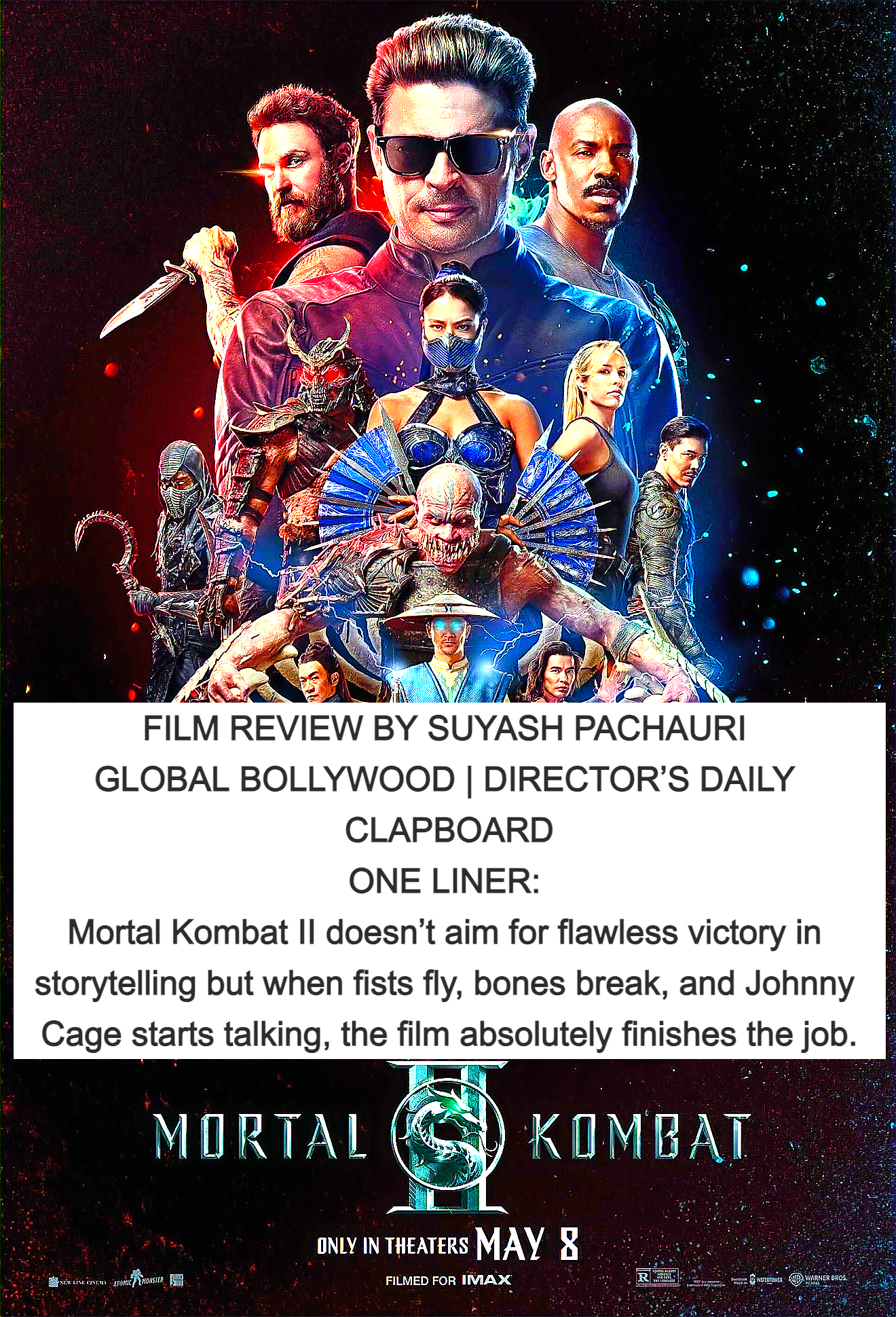
“Mortal Kombat II doesn’t aim for flawless victory in storytelling but when fists fly, bones break, and Johnny Cage starts talking, the film absolutely finishes the job.”