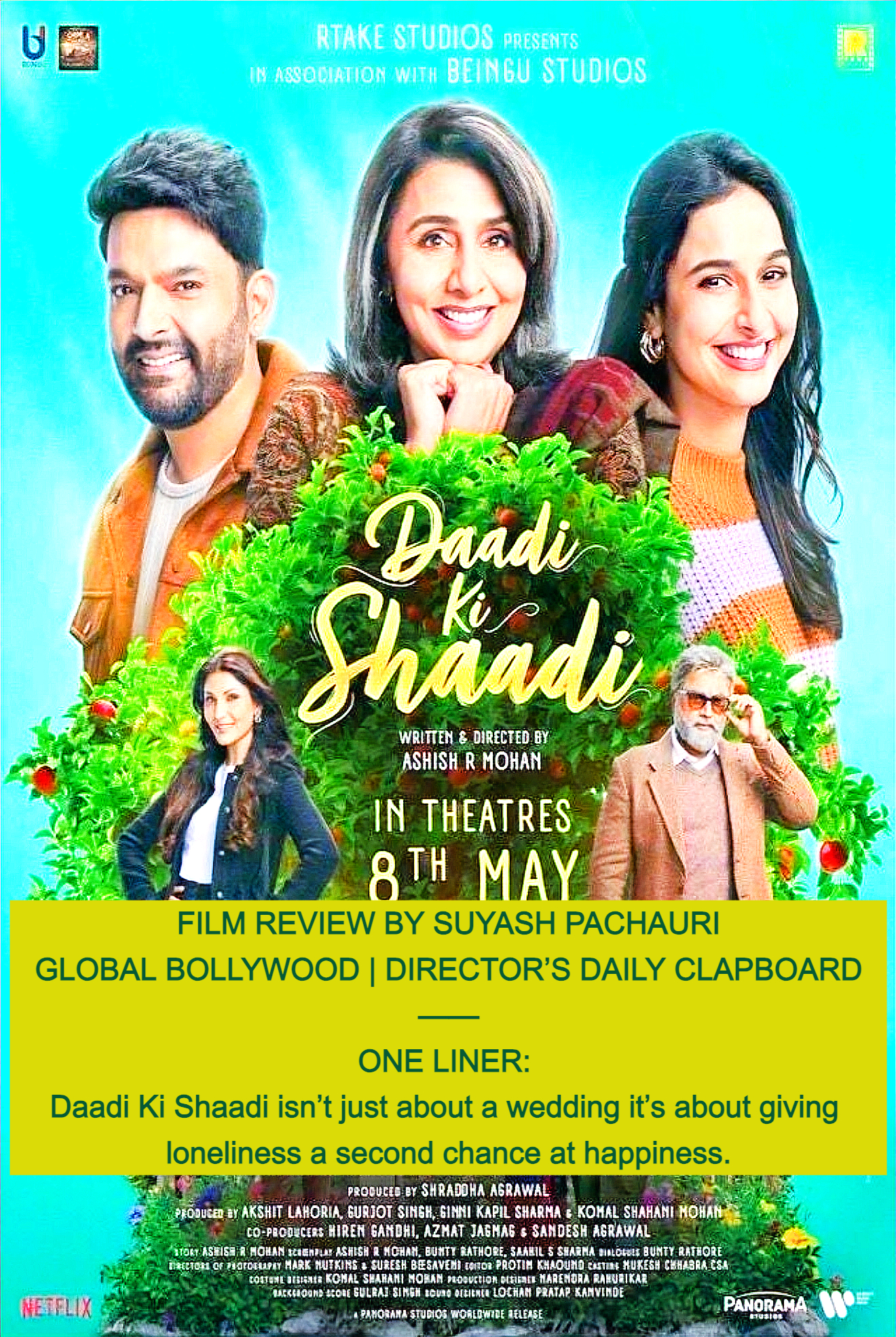
Introduction
In an era where family entertainers often rely either on loud comedy or excessive melodrama, Daadi Ki Shaadi tries to strike a balance between warmth, humour, emotional healing and generational conflict. Directed by Ashish R. Mohan, the film revolves around an unusual but emotionally layered premise an elderly woman deciding to remarry, and the chaos that unfolds inside a deeply opinionated Punjabi family.
What begins as a quirky social comedy slowly transforms into a film about loneliness, second chances, family ego and emotional acceptance. The biggest emotional hook of the film is seeing Neetu Kapoor return to a full-fledged family drama role with remarkable ease, while the casting of her daughter Riddhima Kapoor Sahni adds an interesting real-life emotional layer to the narrative.
The film does not reinvent storytelling, nor does it aim to become a groundbreaking cinematic experience. Instead, it embraces simplicity. Sometimes that simplicity works beautifully, and sometimes it makes the film feel overly stretched. But despite its flaws, the film has enough heart to leave audiences smiling by the end.
Screenplay & Script Sense
The screenplay of the film is clearly designed for family audiences. The writers understand the emotional grammar of Indian households passive-aggressive relatives, judgmental uncles, emotional manipulation, hidden affection and eventually a dramatic reconciliation.
The first half works far better than the second because it keeps the narrative light, playful and situationally funny. The setup involving Daadi’s announcement about wanting to remarry creates naturally humorous reactions from the family members. The writing here feels organic instead of forced. Several scenes involving awkward family meetings, wedding planning chaos and emotional blackmail genuinely land well.
However, once the film enters its emotional territory, the screenplay begins to lose sharpness. The second half becomes repetitive in places. Certain conflicts are revisited multiple times, making the runtime feel longer than necessary. A few subplots involving younger family members feel underdeveloped and are inserted mainly to keep all characters busy.
What the script gets right is emotional sincerity. It never mocks the elderly woman at the center of the story. Instead, it treats her desire for companionship with dignity. That emotional maturity saves the film from becoming a caricature comedy.
Dialogues are simple and conversational. The humour is mostly situational rather than punchline-heavy, which works in the film’s favour. Some emotional scenes feel slightly preachy, especially during the climax, but the emotional payoff still works because the film builds enough affection around its central characters.
Direction
Ashish R. Mohan directs the film with warmth rather than flamboyance. His biggest strength lies in creating believable family interactions. The house feels lived-in, the conversations feel natural, and the emotional confrontations never become overly theatrical.
He also deserves credit for handling a potentially awkward subject with sensitivity. A grandmother remarrying in mainstream Indian cinema could easily have turned into a loud comedy gimmick. Instead, the film treats it as a human story.
The director maintains a breezy rhythm in the first hour. Scenes flow naturally and the humour arrives effortlessly. However, the emotional portions in the latter half become slightly overstretched. The film begins repeating emotional beats instead of progressing toward resolution.
One noticeable issue is tonal inconsistency. At times the film wants to be a quirky comedy, while at other moments it shifts into a heavy emotional drama. These transitions are not always smooth. Still, the director ensures that the emotional core remains intact.
The climax is predictable but emotionally satisfying enough for family audiences. It may not surprise viewers, but it delivers the emotional closure the film promises.
Acting
The heart and soul of the film is undoubtedly Neetu Kapoor. She delivers a performance filled with grace, emotional vulnerability and effortless charm. She never overplays the role. Instead, she brings dignity and emotional depth to Daadi’s loneliness and desire for companionship. Her comic timing remains naturally elegant, and her emotional scenes carry genuine weight.
Kapil Sharma once again proves that when he avoids excessive slapstick, he can be a genuinely effective actor. His performance here feels restrained compared to his television persona. He handles emotional scenes surprisingly well and shares strong chemistry with the family ensemble. He particularly shines in scenes where he is caught between societal expectations and emotional responsibility.
Riddhima Kapoor Sahni makes her acting debut with visible sincerity. Since this is her first film, there are moments where nervousness shows, especially in emotionally intense scenes. Her dialogue delivery occasionally lacks fluency, and some expressions feel rehearsed. However, she carries screen presence naturally and improves gradually as the film progresses. The emotional scenes with Neetu Kapoor work mainly because of their real-life mother-daughter bond, which reflects beautifully onscreen.
R. Sarathkumar brings surprising warmth and maturity to his role. His calm screen presence adds emotional balance to the film. He underplays his character effectively and avoids melodrama completely. His scenes with Neetu Kapoor are among the film’s strongest moments because they feel emotionally mature rather than artificially romantic.
Sadia Khateeb delivers a confident and natural performance. She adds freshness to the film and handles both emotional and lighter scenes comfortably. She brings sincerity to her character without trying too hard to stand out.
Supporting Cast
The supporting ensemble helps maintain the family atmosphere throughout the film.
Tejaswini Kolhapure performs well in her limited but important scenes. She adds emotional grounding whenever the film starts becoming too loud.
Yograj Singh brings authority and humour naturally. His traditional mindset creates several engaging confrontational scenes.
Aditi Mittal provides comic relief without becoming irritating. Her timing works in several family interaction scenes.
Yashpal Sharma remains dependable as always. Even with limited screen time, he leaves impact through his controlled performance.
Nikhat Khan appears briefly but performs effectively within the narrative.
The child actors and extended family members also contribute to the believable household atmosphere. Nobody feels completely disconnected from the story, even though some characters could have been written with greater depth.
Cinematography
The cinematography by Suresh Beesaveni and Mark Nutkins complements the film’s emotional tone nicely. The visual language remains warm, colourful and inviting. The film captures the hill-town setting beautifully, giving the story a comforting visual texture.
Indoor family scenes are framed intimately, helping audiences feel emotionally connected to the characters. Wedding preparations, family dinners and emotional confrontations are visually handled with softness instead of unnecessary glamour.
The film avoids excessive visual experimentation, which actually suits its grounded tone. The cinematography may not be technically extraordinary, but it supports the emotional mood effectively.
Some drone shots and scenic visuals feel slightly overused during transitions, but overall the visuals maintain consistency throughout the film.
Music & Background Score
The music works more as an emotional support system rather than a chartbuster album. The songs blend naturally into the narrative without interrupting the storytelling.
A couple of celebratory wedding tracks bring festive energy and will likely work well among family audiences. The emotional tracks, while not particularly memorable after the film ends, do enhance important scenes.
The background score remains subtle for most of the film, which is a positive choice. Emotional moments are not overburdened with loud violins or manipulative sound design. Comedy scenes also avoid cartoonish musical treatment, helping the humour feel more natural.
However, none of the songs leave a lasting musical impact. The soundtrack serves the film adequately but does not elevate it significantly.
Editing
The editing by Protim Khaound is decent in the first half but slightly inconsistent later. The film flows smoothly during the setup phase, where humour and emotional beats are balanced effectively.
The second half, however, feels stretched. Several emotional scenes could have been trimmed for tighter pacing. Certain confrontations repeat similar emotional information, reducing narrative momentum.
The film probably could have benefited from being at least 15–20 minutes shorter. A sharper edit would have improved the emotional impact considerably.
Still, despite pacing issues, the emotional continuity remains intact and the film never becomes completely disengaging.
Final Verdict
Daadi Ki Shaadi is not a perfect film, but it is a warm-hearted one. It succeeds because it respects its characters and tells its story with emotional honesty. The film carries old-school family drama energy while attempting to modernize its emotional themes.
The biggest strength of the film is Neetu Kapoor, whose graceful and deeply human performance gives the story emotional credibility. Kapil Sharma also surprises positively with a controlled performance, while Riddhima Kapoor Sahni delivers a sincere debut despite visible inexperience.
Yes, the film becomes overlong. Yes, parts of the screenplay feel repetitive. And yes, the emotional messaging occasionally becomes too obvious. But the film still manages to leave viewers emotionally invested.
This is the kind of film best enjoyed with family rather than judged purely through technical perfection. It may not become a cult classic, but it definitely has enough warmth, humour and emotional sincerity to connect with audiences looking for a feel-good theatrical experience.
On the Plus Side
Neetu Kapoor delivers a heartfelt and graceful performance
Strong emotional core about companionship and family acceptance
Natural family humour in the first half
Kapil Sharma performs with surprising restraint and maturity
Warm cinematography and comforting family atmosphere
Emotional scenes feel sincere rather than manipulative
On the Minus Side
Second half feels stretched and repetitive
Predictable narrative structure
Uneven tonal shifts between comedy and drama
Riddhima Kapoor Sahni shows visible inexperience in intense scenes
Music lacks memorable impact
Some subplots remain underdeveloped
One Liner
“Daadi Ki Shaadi isn’t just about a wedding it’s about giving loneliness a second chance at happiness.”